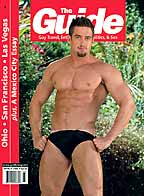
March 2006 Cover
|
 |
Marketlistens!
By
Michael Bronski
Business, Not Politics: The Making of the Gay Market
by Katherine Sender
Columbia University Press
How to order
It's no surprise that gay life and politics these days is driven by gay consumerism. Gay TV, gay magazines, gay vacations, gay movies, gay books, gay jewelry, gay cruises, gay vodka...
well, gay whatever-you-want, not to mention rainbow this and rainbow that. In the late 1960s gay was good. Now gay is good for business.
Mainstream gay spokespeople hail the gay market as a triumph of capitalism over homophobia. In this scenario the more money that
Brokeback Mountain makes at the box office
the less homophobia is in the culture. Well, that's obviously wrong, but probably in a complicated way. More die-hard gay politicos argue that the emergence of a national gay market-- and
the rise of niche marketing and gay-branded goods-- signals the end of a progressive political movement; a capitulation to the evils of capitalism. And that's obviously wrong, but probably in
a complicated way as well.
There's been a great deal written on the emergence and meanings of gay markets. Some of it-- such as the work done by M. Lee Badgett, is quite good-- but much of it, quite
terrible. Katherine Sender's Business, Not Politics: The Making of the Gay
Market is a groundbreaking book that sets a new, far higher, standard for work exploring the interconnections
between advertising, community configuration, and public discourse.
Along with being well-written, perceptive, and nuanced in its arguments,
Business, Not Politics radically reframes many of the basic concepts at the heart of previous discussion of
these issues.
Sender convincingly shows that a clearly defined gay market has been in operation for more than three decades-- a point which goes against the grain of conventional wisdom,
which maintains that this has been true for maybe only the last 15 years. Sender's point is no surprise to anyone who looked at old
Physique Pictorials and Queen's
Quarterly's. The "titles of interest" at the back of mainstream gay-themed novels of the 1950s show that the publishers had a very clear idea of a "gay market." Sender's reframing of this historical timeline is
a seismic assertion, and demands a reevaluation of how "gay markets" and community-formation work.
These examples are merely the tip of the big gay iceberg. Sender's historical arguments here will be vitally important to a new understanding of gay histories as well as
our comprehending the role of consumer and advertising markets on political life.
Of course, the great divide in gay and lesbian political discussions of the "gay market" has always focused on the question of whether or not mainstream marketers targeting of a
gay consumers "is good or bad for gay people." Posing such a unanswerable question has led to pointless fights, and misrepresents the issues involved. Sender cuts through this Gordian
knot by essentially declaring the "good or bad" argument irrelevant and obfuscatory.
Arguing a complicated interplay between "community" and "market," Sender reimagines the basic tenets of the debate.
The issues she raises are relevant to all minority communities. Sender shows that the very notion of what the gay market is, or might be, has changed.
Is "Queer Eye for the Straight Guy" part of the gay market the same way that Absolut vodka ads are? The advent of more mainstream gay-themed popular culture on TV and in
theaters has changed the basic landscape of the discussion, and Sender takes it all into consideration.
Most of all, Sender shows that the gay and lesbian community has been shaped as much by consumer forces as by political interests and ambitions.
While this may sound like yet more common sense, in the ongoing debate over "gay consumerism" and "gay markets" it's a unique and original concept.
Business, Not Politics: The Making of the Gay Market
is a smart book that should be read by anyone interested in business, marketing, or politics.
| Author Profile: Michael Bronski |

|
Michael Bronski is the author of
Culture Clash: The Making of Gay
Sensibility and The Pleasure
Principle: Sex, Backlash, and the
Struggle for Gay Freedom. He writes
frequently on sex, books, movies, and
culture, and lives in Cambridge,
Massachusetts. |
| Email: |
mabronski@aol.com |
You are not logged in.
No comments yet, but
click here to be the first to comment on this
Book Review!
|