That was then
|
 |
A lesbian journey
By
Michael Bronski
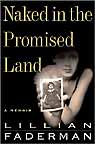
Naked in the Promised Land
by Lillian Faderman
Houghton Mifflin
How to order
We all know, or at least suspect, that behind every extremely respected, highly accomplished, and well thought-of person there is another story. Sometimes this is obvious--is there
any doubt that the social patinas of Messrs. Cheney and Rumsfeld hide a wealth of hideous corruption? Well, actually, the corruption, and the business connections, are barely hidden--but
often they are not. And sometimes the private story behind the public face is surprising, maybe shocking, and revealing.
Lillian Faderman's new memoir--Naked in the Promised
Land--is not so much shocking as liberating and revelatory. Faderman, a respected professor of literature, has been one of
the groundbreaking scholars in women's and lesbian studies. Her books
Odd Girls and Twilight Lovers and To Believe in
Women were influential in mapping out queer history. So when she
writes a personal memoir that discusses her former careers in the late 1950s and the 1960s as a (semi) nude model for men's magazines and as stripper in burlesque shows, it's a stunning
surprise. But the power of Naked in the Promised
Land really comes not from Faderman's forays into sexual subcultures, but in the delineation of her complicated relationship with her
mother. Queerness here is less of matter of modeling (under the
nom de porn of GiGi Frost) in girly magazines, than in figuring out how to love your mother when everything the two of you do
drive the other away.
Lillian Faderman was born in 1940. Her mother was unmarried and prone to mental illness; a situation exacerbated by the fact that she never brought her immediate family to the
US from Europe, and they perished in the Holocaust. Faderman's mother worked in sweatshops in New York where they first lived, and then Los Angeles. And while the daughter spent a
great deal of the time trying to create her own life and flee what she saw as the trap her mother had fallen into, she spent even more time worrying about the fact that she never saved her
mother from this fate. Her mother, in a similar place, lives in fear that Lillian will simply repeat the mistakes she has made--a fear that increases when she discovers that her daughter has
become a model and is running around with a "fast"--as they said in the 1950s--crowd. Much of
Naked in the Promised Land revolves around Faderman's flights from her mother's world, and the
deep regret she had in not being closer to her mother.
While the relationship between mother and daughter is gripping, it's the substance of the author's "flights" that are the most engaging. Faderman's accounts of going to queer
bars, of the butch/fem subcultures of LA, and the excitement of life in the demimonde are all terrific. There are great scenes here--Faderman's crush on famed butch lesbian singer Beverly
Shaw, and the account of her marriage to an upper-middle-class gay man to ensure them both cover.
She is also forthright about her modeling and her stripping (which she did to put herself through Berkeley to get her PhD). Sex work was exciting as a concept, but also often
routine and boring (not to mention somewhat dangerous, as Faderman and other models had little recourse from unwanted sexual attention). Never judgmental, Faderman presents her life as
a logical succession of jobs and adventures in her journey to personal, intellectual, and economic independence. The descriptions of the photo shoots are fascinating as they give a
realistic picture of the "business" of sex work and neither glamorize or moralize.
By the end of the memoir, Faderman has managed to become a noted scholar. Along the way, she finds a life-partner and has a son (well before the lesbian baby boom started),
and creates the life she only could have dreamed of growing up. She does come to terms with her past and by the end of the book has made peace with her dying mother, who has finally
come to understand her own life, and her daughter's in different ways. The power of
Naked in the Promised Land is Faderman's ability to make us understand how her family relationships,
her sexuality, her sexual exploits, and her desire to make a life for herself are all part of the same struggle to survive and become the person she needed to be.
This is queer history at its best.
| Author Profile: Michael Bronski |
|
Michael Bronski is the author of
Culture Clash: The Making of Gay
Sensibility and The Pleasure
Principle: Sex, Backlash, and the
Struggle for Gay Freedom. He writes
frequently on sex, books, movies, and
culture, and lives in Cambridge,
Massachusetts. |
| Email: |
mabronski@aol.com |
You are not logged in.
No comments yet, but
click here to be the first to comment on this
Book Review!
|