Super men
|
 |
Unbreakable packs a punch
By
Michael Bronski
Unbreakable
directed by M. Night Shyamalan
with Bruce Willis, Robin Wright, Spencer Treat Clark, Samuel L. Jackson
How to order
Unbreakable-- the new film released last month by M. Night Shyamalan-- is one of 2000's most interesting.
Shyamalan wrote and directed The Sixth
Sense, which confounded industry experts with its box-office appeal. Marketed as a standard supernatural thriller, audiences nonetheless drank it in as a
moving meditation on death, loss, and marginalization.
Shyamalan has delivered again.
Unbreakable looks at human relationships through the unlikely lens of super-hero comic books. Its opening scenes put it on track to be a routine thriller, even a medical
mystery. David Dunn (Bruce Willis) is a Philadelphia security guard who is in the middle of a painful breakup with his wife Audrey (Robin Wright) and a confusing relationship with his son Joseph (Spencer Treat Clark) when
he becomes the only survivor of a catastrophic train crash. In the trauma's wake, Dunn is contacted by Elijah Price (Samuel L. Jackson), a quirky dealer of vintage comic books. Price intimates that Dunn's survival was
no accident-- that he may, like many comic book heroes, have near supernatural powers, be "unbreakable." Dunn's invincibility is in stark contrast to Price's own infirmity: the comic-book fanatic suffers from a rare
hormonal imbalance that makes his bones break at the slightest impact. At school, other children called him "Mr. Glass."
Drawing on comic-book imagery, Shyamalan has fashioned a stunning-looking film that mirrors both the naiveté and apocalyptic morality of the literary genre that inspires it. On the surface, both Willis
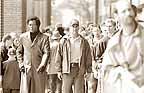
and Jackson are near parodies of their "types." With his hulking build and near-silent demeanor, Willis resembles a depressed super-hero. Jackson here is all nerves-on-the-outside flamboyance, with a wild shock of hair
and bizarrely natty clothes that render him cartooned, yet realistic. Shyamalan uses his characters' affectations as types as much, and as well, as Congreve and other Restorations playwrights used theirs. Within these
conceits, Willis and Jackson conjure vibrant, real people. Willis perfects the vulnerable, wounded male persona that he began in
The Sixth Sense and moves it forward. At points during the film, he shifts so gracefully between
the "man" that David Dunn is supposed to be, and the inner-self that is trapped and expressed through that persona that it is almost as if he is performing a feminist gloss on the traditional "Willis character." Jackson, on the
other hand, really lets go here. His usual method-based emotional constraint is replaced here by an intuitive flamboyance that draws us closer even as it repels. And as Price pursues Dunn with his insistence-- and ever-convincing proof of the security man's non-human invincibility-- a strange, intense relationship develops.
At heart, Unbreakable revolves around the "friendship" between David Dunn and Elijah Price. The latter insists that they are soul-mates-- opposites compelled to find one another in universe that has kept
them apart. But Dunn, uncomfortable with being extraordinary, keeps rejecting this idea/ideal. It is only after Price convinces Dunn that he does indeed, have superpowers (as well as a mandate to use them to do good) that he
is able to accept who he really is. This ever-shifting relationship forms the basis of the film.
On one level, Unbreakable provides us with a non-sexual male/male love affair. Dunn and Price are opposites who come into balance with the universe. How new-millennium, you might think. But
this interracial, homosocial dynamic is hardly new. It's in the relationship between Ishmael and Queequeg in Melville's
Moby Dick, between Jim and Huck in Twain's
Huckleberry Finn, and between Natto Bumppo
and Chingachgook in Cooper's The Last of the
Mohicans. Here, Shyamalan uses the model to explore the shifting ideas and anxieties about the male body.
For it's these images of the male body-- both invincible and fragile, unbreakable and broken-- that give
Unbreakable its power. Both Willis and Jackson invert their own previous images as
hyper-masculine, aggressively sexual "real men." By turning these preconceptions on their heads, Shyamalan jangles our perceptions and expectations. Both Willis and Jackson cease to simply "be" the men we've seen in the past as
they consciously portray new images of disoriented masculinities. As the film moves us through its iconographic narrative-- filled with typical comic-book set-ups and plot devices-- it becomes clear that he's testing
new possibilities of what it means to "be a man"-- in both the traditional world of boys' comics as well as the material world.
The film's conclusions are unclear. Certainly Shyamalan is tossing out the old stereotypes of maleness, but doesn't replace them with clear alternatives. Or perhaps that is Shyamalan's point-- all roles are
comic-book roles, there is no "real," more honest masculinity that can be ascertained or attained in our culture. That is very new-millennium fear-- or opportunity. Expressing that anxiety so well makes
Unbreakable one of the most provocative and unsettling films to come out of Hollywood in a while.
| Author Profile: Michael Bronski |

|
Michael Bronski is the author of
Culture Clash: The Making of Gay
Sensibility and The Pleasure
Principle: Sex, Backlash, and the
Struggle for Gay Freedom. He writes
frequently on sex, books, movies, and
culture, and lives in Cambridge,
Massachusetts. |
| Email: |
mabronski@aol.com |
You are not logged in.
No comments yet, but
click here to be the first to comment on this
Movie Review!
|