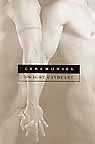
Ceremonies
|
 |
An anti-gay murder refracts through a small town's life
By
Michael Bronski
Ceremonies
by Dwight Cathcart (Calamus Books, paper, $18.95)
How to order
A gay man walking over a bridge in a town in Maine is attacked, beaten, and thrown into the water by three teenaged boys. He drowns, the boys are arrested, and the story makes
the national papers. It's an act of violence that could happen anywhere. It did happen in 1984 in Portland, Maine, when Charles Howard was murdered. Violence never occurs in a vacuum.
Dwight Cathcart's wonderful debut novel based on Charles Howard's murder details how the crime changed the lives of nearly a dozen people and the city in which they live.
Cathcart, who was friends with Howard, has fictionalized Portland into Cardiff and Howard into the flamboyant, openly gay Bernie Mallett. But Mallett's death is simply the
departure point for Cathcart's story. Through a series of first-person interior monologues he brilliantly constructs a series of mirrors a serious fun house that reflect and refract the
endless ramifications of the tragedy upon an ever widening circle of people and on the life and politics of the town itself. It is through these introspective, deeply personal explorations that we
begin to understand not only the whole society in which Mallett lived and died, but, more important, how the intricacies of personal lives and choices shaped and were shaped by his life.
"Only connect" wrote E.M. Foster, and while the characters here do relate and "connect" to one another around Mallett's death, Cathcart's broader theme here is that, in some
profound way, it is impossible not to connect, not to be affected by what happens around us, and by the events close or far that happen in the world.
After Mallett's death, a political action group forms in Cardiff to confront some of the issues raised by his murder. And while it's clear that political action has the possibility to
create a better, safer society it is the personal transformations these moments of connecting that perhaps matter more.
These moments fuel the novel. Cathcart's prose is measured and deeply literate, and the epiphanies experienced by his characters form a series of mosaics that bring Cardiff vividly
alive. Sometimes they are just observations Dana, a lesbian, reflects that "... you never get to the end of coming out: on the other side of the glass there is always another tour group
coming through who have never been there before" but often they are of a more personal nature. Cathcart is able to conjure the inner emotional lives the fears, the demons, the hopes of
his characters.
Ceremonies succeds in capturing the terrors and the exhilaration of living outside of urban gay centers. Craig, a gay man who lives and does queer political work in Boston, wonders
why any of the people who have organized a coalition in response to Mallett's death even stay in Cardiff "These people are dealing with issues that the rest of us have dealt with in 1970."
Weaving a seamless web connecting the personal to the political, the inner life to the world around us, Cathcart makes clear that the vibrancy of being gay, or queer, or
homosexual resides in each individual and can be the catalyst that moves us to insight and often to action.
So often works of fiction that are inspired by "real" events are overshadowed by the harshness or vividness of their inspiration. Dwight Cathcart's splendid novel transfigures
Charlie Howard's murder into something that mediates our rage to understanding, our sorrow to our ability to challenge and change the world.
| Author Profile: Michael Bronski |

|
Michael Bronski is the author of
Culture Clash: The Making of Gay
Sensibility and The Pleasure
Principle: Sex, Backlash, and the
Struggle for Gay Freedom. He writes
frequently on sex, books, movies, and
culture, and lives in Cambridge,
Massachusetts. |
| Email: |
mabronski@aol.com |
You are not logged in.
No comments yet, but
click here to be the first to comment on this
Book Review!
|