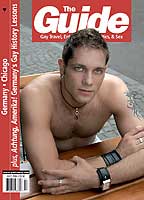
July 2004 Cover
|
 |
How the movement launched
By
Mitzel
I have this new title in my bookstore which is my favorite of the season. It is
At Ease: Navy Men of World War II. It was put together by Evan Bachner; he spent six years tracking down
the photos in this collection. He found the bulk of them in the "Naval Aviation Photographic" unit at the National Archives. He searched through hundreds of boxes. Amongst the quotidian
pix, Bachner found photos that "told a story which was not about battle, but about the less heralded experiences of a soldier's life when the war goes elsewhere for a moment."
It turns out that the Naval Aviation Photographic Unit was due to the work of Edward Steichen. Steichen had started as a painter. He served in the Army in WWI, in supervising
aerial reconnaissance and documenting war work. After the war, he switched permanently to photography.
Just before the beginning of WW II, Steichen was 61-years-old and tried to re-enlist in the Army. He was turned down as too old. After Pearl Harbor, he convinced the Navy to take
him on. They did. He had a number of assignments; one was with the Naval Aviation Photographic Unit. He hired a team of photographers. Photos were taken of men in training; the bulk of
the photos were taken on ships in the South Pacific. Other themes were women in the military, African-Americans in the ranks, the occupation of Italy, the liberation of Guam and the
Philippines. At Ease focuses on men on ships in hot weather in the battle of the Pacific.
"In the years following World War II," Bachner writes, "images of comradeship, particularly of men being physically close, largely disappeared from the public record." He quotes
John D'Emilio, who wrote: "Army canteens witnessed men dancing with one another, an activity that in peacetime subjected homosexuals to arrest. Crowded into port cities, men on leave
or those waiting to be shipped overseas shared beds in YMCAs and slept in each other's arms in parks or in the aisle of movie theaters that stayed open to house them. Living in close
quarters, not knowing whether they would make it through the war and depending on each other for survival, men of whatever sexual persuasion formed intense emotional attachments."
At Ease is a document of these attachments.
It captures the homosocial and homoerotic atmosphere of large numbers of men, on ships, at the Equator, not knowing what the morrow might bring. The young men photographed
in this volume are all attractive, well, at least to me-- I am afflicted with what Walt Whitman called "amativeness." They have the look of males born in the 1920s, wholesome looking
All-American types. It was a massive mobilization, guys from Anytown, USA, found themselves deployed around the world. For all of them, it was an adventure, a scary one, but an
adventure. And all were called. When war comes, the screening out of gay men and lesbians goes to back-burner status, something self-evident.
I had two friends, now both dead, who were conscientious objectors during WW II. These were Victor Chapin, an actor, writer, and literary agent, who had grown up in the pacifist
culture that had developed after WW I, and Wallace Hamilton, also, late in his life, a writer, who attended Harvard in the same class as JFK (as part of their intake at Harvard, each new freshman
was photographed in the nudefront, back, side: Wallace once told me, late in his life, that he had gone back to Harvard to see his nude pix and asked to see those of JFK; he was informed
that those of Kennedy had been removed from the collection).
I can't recall why Wallace had become a CO. He did tell me that he was assigned to be a guinea pig at Mass. General Hospital, subject to experiments in hypothermia trials,
water submersions, etc. On the other hand, my father became a naval officer, served in both the Atlantic and Pacific campaigns, and, to the extent he ever speaks of his war experiences, had
a good time. It was a change from Rocky River, Ohio. But my Dad, like many of the war vets, just saw it as a duty, not something core to his identity.
Some gay historians have offered the idea that the modern gay movement was really the product of the mass mobilization of the Second World War. I tend to agree with this
analysis. Millions of men and women were mobilized, taken from their familiar locales, exposed to a huge military culture and foreign venues. And, as D'Emilio notes, many of the
servicepeople participated, or could participate, in a homosocial culture. A lot of the social justice movements that came after WW II were empowered by the impact of the war, certainly the language
used to rally public opinion. And many folks, after demobilization, didn't return to their place of origin. Many thousands relocated to major American cities and helped grow and format the gay
and lesbian communities in the 50s and 60s. There were aggressive reactions to changes initiated by the dislocations of the war; there were also progressive developments-- think of
the founding of the Mattachine only a few years after the war; how many were vets?
When I look at the pictures in At
Ease, which I do often, it may make the war look a little too much buddy-buddy and a little too cruisy. These young men were on a metal ship; it
must have been hot and smelly; the food was probably so-so; the sanitary conditions just passing muster. But when the cameras started clicking, these guys had the right attitude and liked
the attention. And it shows. Wonderfully.
You are not logged in.
No comments yet, but
click here to be the first to comment on this
Common Sense!
|