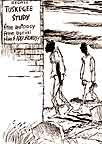
Tuskegee 1
|
 |
Secret HIV testing rankles some
In its notorious Tuskegee
experiment, US health authorities
from 1932 to 1972 let hundreds of
black men with syphilis suffer and
die without treatment just to see
syphilis's cruel effects run rampant.
Did the ghost of
Tuskegee return to haunt New York
City? So charged AIDS activist
Michael Petrelis, project director of
AIDS-Statistics.com on
September 5, lambasting a nine-year
study by the New York City
Department of Heath that secretly
tested gay men for HIV and-- adding
perhaps injury to insult-- failed to
inform those found infected. Did
Petrelis catch Tuskegee's ghost in
the act?
From 1990 to 1998, New York
tested blood for HIV of thousand of
men who came to two city clinics--
one in Manhattan's Chelsea, another
in Fort Greene, Brooklyn-- to be
tested for syphilis and other
sexually transmitted diseases
(STDs). The researchers used
leftover blood, normally discarded,
and recorded demographic data--
age, ethnicity, reported sexual
orientation-- but supposedly nothing
that would link a blood sample
to anyone in particular. And New York
wasn't alone-- similar studies, under
the auspices of the US Centers for
Disease Control, looked without
asking at the blood of pregant
women, prisoners, TB patients, and
other groups.
People seeking treatment for
STDs can be a rich vein of
information about AIDS; indeed, they
can represent the "yeast" of an AIDS
epidemic: they are sexually active in
ways at least somewhat risky, at
the same time that having an STD
can make it easier to get or give HIV.
After nine years of compiling data,
New York's City's Department of
Health created a kind of motion
picture of HIV prevalence in a
signal population-- a picture of a loaf
not rising but, happily, falling on
average by more than half.
The Department of Health
reported its findings in July at this
year's international AIDS conference
in Durban, South Africa: the rate of
HIV infection among "men who have
sex with men" showing up at
these two STD clinics declined
overall from 47 percent in 1990 to 19
percent in 1998. Of those who tested
positive for HIV, some 59 percent
were aware of their status, but 41
percent were not. For that latter
group, the
Health Department was in the
curious position of doing extended
treatment, contact tracing, and
partner notification for such
conditions as syphilis and
gonorrhea, while ignoring the men's
secretly discovered HIV.
In a press conference outside
the office the study's author, Dr. Lucia
Torian, Petrelis demanded that New
York City try to track down the
unknowing HIV-positive men and
inform them of their status.
But the city Department of
Health has refused, saying that
doing so would be unethical.
Moreover, the city says, it simply can't
be done because there is no way
trace back the HIV-positive blood to
its
donor precisely because ethics rules
were followed that were devised in
the aftermath of Tuskegee-- rules
that allow subjecting patients' tissue
to tests to which they don't give
consent, so long as no link exists
between results
and their identities.
Comparisons to Tuskegee
are unfounded, the city maintains. No
one was bribed or lied to about their
health. The study served as a "dip
stick" reading of HIV prevalence in
important populations, not a
hands-off experimental meditation
on how people die. At every turn,
visitors to city clinics are encouraged
to get HIV testing, which is offered
anonymously and free. And there are
good reasons for not forcing people
to take
HIV tests or giving people the results
of unrequested ones-- they may not
be ready to hear the results.
Prevalence surveys like this
can help figure out which groups to
target for education and treatment.
Interesting nuggets came out here:
the overall decline revealed local
lumpiness. Over the nine-year
period,
the decline in HIV among
clinic-goers was greater among
whites (34-10%) than Hispanics
(47% to 13%) and blacks (56-32%).
Among men having no STD, HIV
infection plummeted from 48 percent
to 10% in 1998. But
in older black
men-having-sex-with-men, the rate of
HIV infection increased.
So are secret, albeit
identity-protected, epidemiological
surveys the place to find shades of
Tuskegee today? Consider another
New York City institution-- Cornell
Medical College-- sponsor of a
long-running
study conducted in Port au Prince,
Haiti, that looks at how couples
where one partner has HIV
sometimes infects the other. If
researchers can find some people
with a natural resistance to HIV, it
could help find an HIV
vaccine. Enrollees get condoms and
counseling, but infections occur
anyway, at a rate of about seven
percent a year in couples having
unprotected sex-- a rate that would
be far lower if those infected with HIV
received
antiretrovirals, which dramatically
reduce virus loads in body fluids.
While Cornell's enrollees get some
of the best free health care on offer in
Haiti, expensive retrovirals are not
part of the deal, just like it is in
almost every
other impoverished country. And if a
vaccine is ever developed, Western
liability laws mean that it will be
tested first on the poor and
dark-skinned.
Unfair? Yet righteous
indignation at any particular project
has to be tempered by awareness of
the systemic choice by the rich world
to impoverish poor nations'
health-care systems in the guise of
"structural adjustment"-- not to
mention a tendency of third-world
elites to prefer guns to butter. "The
ethical issues sometimes are
torturing me,'' Dr. Jean William Pape,
the Hatian doctor who runs Cornell's
study, told the
New York Times last year. The
ghost of Tuskegee may not haunt the
corridors of New York City's
Department of Health, but it still
haunts medicine.
You are not logged in.
No comments yet, but
click here to be the first to comment on this
News Slant!
|