|
 |
Is Brokeback too tame?
By
Michael Bronski
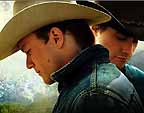
Brokeback Mountain
Directed by Ang Lee
Starring Heath Ledger,
Jake Gyllenhaal
How to order
All right, it's true I haven't seen Brokeback
Mountain yet-- it doesn't open in my "selected theater" until tomorrow-- and I'm sure it's as well done as all of Ang Lee's films are, is the "breakthrough" queer film that the gay press (and the studio press-people) keep
insisting it is. Even in our Queer Eye for the Straight
Guy and Will and Grace culture, a feature film with a gay love story at its center is still an anomaly.
But there are two things that strike me as odd.
The first is that no one is really looking at the tone of the positive mainstream reviews-- basically we're just happy that they're there.
Here's a sentence that appeared in a very positive review of
Brokeback Mountain in Gay Chicago magazine: "After their initial romantic coupling, both men make a point of proclaiming that they are not 'queer,' and indeed their sexual bond is borne out of loneliness and
isolation more than anything else." While this is from a gay publication, variants of this sentence appear widely. And let's not forget that the film (and story) are almost always described as "tragic"-- this may be an intense love, but it's as doomed as that of Romeo and Juliet or Leopold
and Loeb.
What strikes me as curious is that while the gay press is touting the film as a major gay love-story, the message in the reviews seems to be that the passion between the two men is less about desire and lust and more about "loneliness," "isolation," and those cold nights
out on the prairie with the sheep. E. Annie Proulx's short story is always described as terse and spare, but feels to me to be both underwritten and at times emotionally overblown: Zane Grey's
Riders of the Purple Sage crossed with Fannie Hurst's
Back Street (or it is Riders of the
Purple Prose crossed with Back Door
Boys?). But Proulx's story gives no indication that the lust of these men is about isolation. I mean, they spend years cheating on their wives and can't keep their hands off one another. Their sexual encounters are described as urgent, not incidental.
While the film is being advertised as a potent love story, we're also being told that there's hardly any sex, and what there is, is discreet and in the dark.
So what's going on? Is Brokeback
Mountain really a brave film about gay love-- about "Love is a Force of Nature," as the tagline states-- and it's just that clueless reviewers are miscasting it as a story about situational homosexuality?
Whatever's in the film is being gingerly handled by the advertising and the publicists because, even in 2005, there will be no large audiences (even of heterosexual women who are described by the studio as the film's target viewership) for a gay male love story.
2004 election revisited?
Which makes one aspect of the media excitement for
Brokeback Mountain quite interesting. Why has it gotten such enormous attention? Generated such massive pre-release publicity? Sure, it's probably a well made film, and sure, a gay love story with two hot Hollywood
stars is unusual. But this sort of excitement doesn't happen in a cultural vacuum, or just from publicists working late hours shilling product to bored reviewers and editors.
I suspect that the excitement is a response to the fight around gay marriage. And that the mixed messages we are getting from the reviews-- describing it as an intense love story between two men who are only lonely with hot sex that we never see-- is emblematic of
how deeply divided our culture is-- not only about gay marriage, but homosexuality in general. The template for this ambivalence is clear in
Brokeback Mountain's basic narrative: gay love and passion exist and are valid even hyper-romantic, but also tragic and doomed and mostly not visible.
The contradictions that we see in the marketing and the reviews of
Brokeback Mountain are identical to how many people in what is commonly called "mainstream culture" view gay men: not so much old-style pathetic, dangerous perpetrators of social unrest, but
highly attractive exotic creatures who are doomed to tragic love. Public opinion polls showing nascent approval of gay people is on the rise at the same time as voters are going to the polling booths to pass constitutional amendments that, in many cases, would not only ban gay
marriage but most public, and sometimes, private forms of partnership recognition.
The problem posed by gay marriage wasn't so much a legal one for many right-wing heterosexuals, as it was a physical one: how do you reposition a fascination with gay people with an underlying mistrust and fear of sexual difference? And when you factor into this
equation the reality that most people are, on some level, unhappy because their heterosexual marriage and life is not the ideal romantic fantasy that they'd been sold by Hollywood, the potential for social and physic unease is even greater. The solution to this is a trip to
Brokeback Mountain, where the men are beautiful, the passions run high, the sex isn't obvious, and no one is happy in the end. It's the perfect unhappy Hollywood homosexual fantasy for people who've been disillusioned by the traditional Hollywood heterosexual fantasy.
| Author Profile: Michael Bronski |

|
Michael Bronski is the author of
Culture Clash: The Making of Gay
Sensibility and The Pleasure
Principle: Sex, Backlash, and the
Struggle for Gay Freedom. He writes
frequently on sex, books, movies, and
culture, and lives in Cambridge,
Massachusetts. |
| Email: |
mabronski@aol.com |
You are not logged in.
No comments yet, but
click here to be the first to comment on this
Movie Review!
|