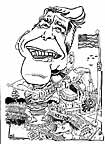
Fiddling in America
|
 |
Prez who fiddled while gays died remembered fondly
By
Jim D'Entremont
The great masses of the people... will more easily fall victim to a big lie than a small one.
–Adolf Hitler
Ronald Reagan, 93, the B-movie actor who became the 40th President of the United States, had the longest decline of any world leader since Spain's Francisco Franco slipped into
twilight in the 1970s. When Reagan left office in January 1989, he already exhibited signs of Alzheimer's disease. The most surprising aspect of his death was that it had not occurred long
before June 5, 2004.
As US Rep. Roger Wicker (R.-Mississippi) observed, however, in a recent eulogy, Reagan was "blessed with... a sense of timing." Reagan's demise handed George W. Bush a
ready-made propaganda coup at a time of plummeting opinion polls and an escalating reelection fight. The Reagan obsequies were shaped not just to sanctify the deceased, but to envelop Dubya in
his father's predecessor's holy mantle.
During week-long observances culminating in a National Day of Mourning, orators pumped up Reagan's stature to Lincolnesque dimensions. "Now he belongs to the ages,"
intoned President Bush. "Ronald Reagan was more than an historic figure," gushed Vice President Dick Cheney. "He was a providential man who came along just when our country needed him."
The media kept negative opinion tightly contained, as if to insure that any factual assessment of the Reagan Administration would be met with cognitive dissonance.
Memorable performance
Despite Republican efforts to erase America's historical memory, many Americans who made it through Reagan's eight-year reign find the horror of that period unforgettable.
Some veterans of the struggles over AIDS and gay rights found ways to protest the Presidential hagiography. On the day of Reagan's funeral, the National Gay and Lesbian Task Force shut
down its offices in commemoration of the thousands lost to AIDS. In San Francisco, the Lesbian Gay Bisexual Transgender Center put up a sign reading, "His failure, their deaths, our mourning."
In the early '80s, the Reagan Administration's morally punitive gatekeepers responded to AIDS with silence and a funding shutout. While the US government spent millions
on Legionnaire's disease, AIDS research received minimal support. When Surgeon General C. Everett Koop espoused AIDS education and condom use, he was muzzled; his report on
HIV/AIDS lay unread on Reagan's desk for over six months. By the time Reagan finally acknowledged the pandemic in 1987, 71,176 Americans had contracted AIDS and 41,027 had died.
Since most people with AIDS were gay men, administration officials appeared to consider AIDS fatalities second-class deaths. Reagan had surrounded himself with hardshell
homophobes. His top domestic advisor was Gary Bauer, founder of the anti-gay Family Research Council. Moral absolutist crackpot William Bennett was Reagan's Chairman of the National Endowment
for the Humanities and later Secretary of Education. Everywhere in the Administration, moral crusaders like Pat Buchanan lurked.
In political campaigns, Reagan made a point of soliciting endorsements from key Christian groups. The 1980 Presidential election was the evangelical voting bloc's first unequivocal
show of strength. Some religious conservatives later grew impatient with their President's slowness to sell their agenda. But while Reagan was in office, Christian fundamentalists
harnessed broadcast media and gained unprecedented clout. As Haynes Johnson states in
Sleepwalking Through History: America in the Reagan
Years, "Televangelists flourished because
they combined all the elements that most characterized the Reagan era: money, morality, conservatism, entertainment, and religious and patriotic symbolism."
Reagan's funeral panegyrics stressed the "deep religious faith" of a man who avoided church attendance and seemed, like most of his family, not to subscribe to any identifiable
belief system (though his wife consulted astrologers and his daughter Patti did study yoga). When it seemed politically expedient, Reagan claimed to be "born again." His most noteworthy
religious quirk was his fascination with Armageddon and the cultish Biblical prophecy writings of Hal Lindsey, author of
The Late Great Planet Earth, a screwball classic. His devotion to "family
values" notwithstanding, Reagan, the only divorced President, had difficult relationships with most of his children and paid his grandchildren scant attention.
In 1985, grandstanding on behalf of Reaganite "traditional values," Attorney General Ed Meese convened a commission intended to reverse earlier findings that pornography
was harmless. Commissioners included Rev. James Dobson of Focus on the Family, Christian activist Alan Sears, and Father Bruce Ritter, a closeted gay Jesuit. The Meese Commission
report, though easily discredited, marked the start of a continuing rise in censorship.
With the same degree of tact he would later apply to a visit to the last resting place of Nazi soldiers in Bitburg, Germany, Reagan kicked off his 1980 election campaign in
Philadelphia, Mississippi, near the site of the 1964 murder of three civil rights workers. In a region where "states' rights" means Federal noninterference in segregation, Reagan cheerfully affirmed
his belief in states' rights. This incident, along with biased housing policies pushed while Reagan was Governor of California, his dismantling of antipoverty programs, his disparagement of
black single mothers as "Welfare queens," and his "constructive engagement" (i.e., renewed arms sales) with pre-liberation, pro-apartheid South Africa, did not endear Ronald Reagan to
African-Americans.
Impatient with the details of policy-making-- and with facts, which he considered "stupid things"-- Reagan approached domestic and foreign policy with equal carelessness. The
fantasy that Reagan single-handedly ended the Cold War reveals public delusion about the efficacy of his savagely hawkish rhetoric targeting the "Evil Empire," the Soviet Union. Reagan's
rejection of diplomacy, popular with US chauvinists eager to kick ass, might have spelled disaster if Russia had been in the hands of anyone other than Mikhail Gorbachev. Super-patriots longing
for Rambo gestures felt cheated, finally, when Reagan and Gorbachev moved toward arms control.
More troubling was the Iran-Contra affair. This contretemps arose from an illegal Executive Branch effort to take matters into its own hands in the Middle East and Latin America.
One goal was to free American hostages held in Lebanon by selling arms to Iran. This meant ignoring Iran's sponsorship of terrorists who had just killed over 200 US Marines in Beirut, as well
as its state of war with America's Iraqi ally Saddam Hussein. A secondary aim was to funnel Iranian money (via drug traffickers) into the pockets of the Contras-- Nicaraguan right-wing
"freedom fighters" Congress had declined to fund. Reagan may have been semi-oblivious to what was happening (he often was), but his public commendation of arms emissary Oliver North as
a "national hero" made his feelings toward the covert operation unambiguous.
Far more serious than Watergate, the affair received less rigorous Congressional and journalistic scrutiny. The mentality that produced the Iran-Contra scandal remains submerged
in ongoing efforts on the part of the Executive Branch of government to subvert the Legislative Branch, to bypass the system of checks and balances laid out in the US Constitution, and
to duck accountability.
Reagan's eulogizers gave the Iran-Contra unpleasantness a wide berth. They also made little or no mention of his Keystone Kops invasion of Grenada; his promotion of a
boondoggle called the Strategic Defense Initiative; his support of Central American death squads; his support of Afghan antecedents of the Taliban; his inattention to the looting of American
savings-and-loans; his proliferation of homelessness; or the monstrous deficit his Reaganomic strategies produced.
The prosperity of the Reagan years was Reagan's gift to the already prosperous. The gulf between wealth and poverty yawned wider through the 1980s. The zeitgeist belonged to
the likes of insider-trading prodigy Ivan Boesky and junk-bond trickster Michael Milken. Greed became chic in a world of mergers, acquisitions, and shady deals. With Meese's Justice
Department exercising minimal regulatory oversight, anti-trust laws appeared obsolete.
Hollywood on the Potomac
Reagan's political career grew out his involvement in the Screen Actors Guild and his eight-year stint as chief shill for an archconservative corporate entity, General Electric. The
Great Communicator was a somewhat underrated actor who did well when handed a script. With skill refined in countless hackwork films and television shows, he brought pristine sincerity
to obfuscation, oversimplification, and homespun bullshit.
Endowed with the happy-go-lucky fraudulence of a seasoned grifter, Reagan satisfied the American appetite for the warm and the runny. "It's morning in America," his signature
slogan proclaimed. His speeches were stuffed with references to God, family holidays, faithful dogs, the flag, lonely soldiers shivering through Christmas in unseemly foreign climes while saving
our democracy from unwashed hordes, and "feeling good about America."
Not everyone responded, though. Gallup polls place Reagan's overall approval rating at 52 per cent, putting him well behind Roosevelt, Eisenhower, and Kennedy; slightly behind
Johnson and Clinton; and only four points ahead of the much-maligned Richard Nixon. From the moment of Reagan's 1980 victory over Jimmy Carter, the popularity myth was kept afloat by
right-wing Republicans, validated by corporate media, and countenanced by willfully half-asleep Democrats. The broadcast correspondents who fabricated that myth also popularized
Reagan's image as the "Teflon President"-- the leader to whom nothing unsavory could stick. And in fact, they carefully avoided letting any muck adhere.
With Teflon impunity, the Reagan regime may have undermined American democracy in irreparable ways, redefining US society and repositioning it far to the right. As a
certifiable sociopath, George W. Bush may indeed be the spiritual heir of Ronald Reagan, a man whose legacy may best be understood wherever "morning in America" resembles midnight.
You are not logged in.
No comments yet, but
click here to be the first to comment on this
News Slant!
|