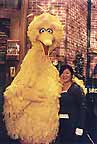
Cho & chicken
|
 |
Blow him. And that's not a gay joke
By
Michael Bronski
Notorious C.H.O.
Written by Margaret Cho
directed by
Lorene Machado
How to order
Everybody likes to hear people talk dirty. And when women talk dirty it's even funnier. Of course to be really funny when talking dirty you actually have to be talking about
something else. When Lenny Bruce talked dirty he was really talking about politics. When Richard Pryor talked dirty he was usually talking about race. And when women comics in the 1960s,
such Rusty Warren, talked dirty, they were actually talking about feminism. What's surprising about the stand-up comedy of Margaret Cho-- particularly in
Notorious C.H.O., the film-version of her last touring show-- is that for lengthy portions of it she's actually not talking about race or politics, but simply about sex.
Written by Cho and directed by Lorene Machado, this is a tolerably standard presentation of a stage performance. There's nothing surprising about the look of the film-- aside
from a prologue and an epilogue in which audience members, and Cho's parents, get interviewed. Margaret Cho is recorded presenting her material in front of five cameras that give us
close, medium, and long shots. But writer and performer are willing to push the envelope with sex talk. Speaking of getting fisted, Cho claims it makes her feel like a Muppet. A guy-- a big
guy-- she goes down on in an SM sex club "has a dick so big it had a dick on it." Confessing to being a lover of cocksucking, Cho also says she sometimes likes eating pussy, but she
is surprised when she does-- "I can't believe it's pussy" she explains again and again. But while cocksucking is fairly tidy "you have to have a lobster bib on when eating pussy."
Cho is funny, even more so when she's being relentless, like when she rails about a boyfriend, annoyed by the fact that Cho takes a little extra time for her orgasm and says
"why can't you come when I fuck you?" But so much of Cho's humor works because she's a woman doing what are essentially gay male comic routines. This isn't to say that Cho's
jokes aren't based on her own experience, or that she's derivative, but simply that the style and content of her work comes out of gay culture. The fact that Cho grew up in San Francisco
and hung out with a queer crowd-- and is certainly pretty ambisexual herself-- explains part of this. She has a very funny routine about her two best friends in high school who were
drag queens who died of AIDS and are her Guardian Angels advising her from above how to dress and how to make her boyfriend come more quickly. But the inventiveness of Margaret Cho
as a writer and performer is that she's found ways to take this gay male tradition and make it work for herself as a (mostly) heterosexual woman, without turning herself into a drag
queen or some odd-girl-out-fag-hag-type who's all imitation and no invention.
Less sugar, more puppy-dog tail
Cho achieves part of this simply by the force of her own personality. While the idea that a dick was so big it had a dick on it sounds like classic gay bar-speak, Cho makes us
believe that the phrasing is unique to her and her life. We can imagine how much she liked the dick; it makes sense. There are few other women comics who could get away with this--
Rosanne in the old days, maybe-- and that's fine. This is rare stuff-- the sort of jokes that can make you laugh and semi-gasp at the same time-- and the field is understandably narrow.
Bette Midler could barely have gotten away with some of this stuff in the 1970s and she, more than any other performer at the time, drew enormously on gay culture. But Midler-- despite
her drag-ish Devine Miss M. persona and her flash and trash style-- was essentially a social commentator and a good girl at heart. That's why she always pretended to apologize after
telling her Sophie Tucker jokes and why she so often (and sometimes quite beautifully) veered off into sentimental territory. Cho is hardly ever sentimental-- she can use the idea
of sentimentality to set up a joke as when she speaks of going to Ground Zero to help out-- by blowing all of the rescue workers-- but she refuses to stay there very long. She
understands that the ability to talk frankly about sex is predicated upon making it funny, and by never compromising by getting emotional or romantic. It's a lesson that gay men-- and
gay performers-- have known for a long time, and that the world might profit from hearing of hearing more often. And they are more likely to hear it from Margaret Cho these days
than anyone else.
| Author Profile: Michael Bronski |
|
Michael Bronski is the author of
Culture Clash: The Making of Gay
Sensibility and The Pleasure
Principle: Sex, Backlash, and the
Struggle for Gay Freedom. He writes
frequently on sex, books, movies, and
culture, and lives in Cambridge,
Massachusetts. |
| Email: |
mabronski@aol.com |
You are not logged in.
No comments yet, but
click here to be the first to comment on this
Movie Review!
|