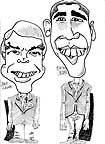
Some questions for you, gentlemen...
|
 |
By
Jim D'Entremont
On November 4, 2008, when US voters elect their 44th president, their choice will tell the world what kind of country they want to inhabit after George W. Bush is returned to Crawford, Texas, on permanent vacation. Meanwhile, the long dissonant overture to that occasion
plays on. Its themes include Iraq, immigration reform, health care, energy conservation, fiscal responsibility-- and Iraq. But sexual and reproductive motifs, especially gay rights and abortion, still retain considerable power to engage blocs of voters and send them marching to the polls.
"The differences between the Democratic and Republican fields of candidates on lesbian, gay, bisexual, and transgender issues are startlingly stark and profoundly depressing," noted Matt Forman, executive director of the National Gay and Lesbian Task Force (NGLTF), in a
statement accompanying the release of a scorecard measuring the candidates' positions on a range of GLBT concerns. Democrats' scores were uniformly high; Republicans' scores were abysmal.
This is not to say all Democrats are eager to wave the rainbow flag. With regard to gay issues, most Democratic candidates have adopted boilerplate positions that facilitate evasion. In their give-and-take with leading gay advocacy groups-- the Human Rights Campaign (HRC),
the Gay and Lesbian Alliance Against Discrimination (GLAAD), NGLTF-- they have negotiated and sometimes dictated which topics can be addressed. This pantheon includes same-sex unions, military service, hate crimes, and antidiscrimination measures.
"In this campaign," complains New York ACT UP veteran Bill Dobbs, "we're being made to view our issues through the tunnel vision of GLAAD. What can you say about gay activists whose thoughts are dictated by clowns from the two major parties?"
With friends like these...
For Democrats, overtly homophobic rhetoric may now be suicidal, but straightforward endorsements of gay objectives that rattle too many cages, whether assimilationist (marriage equality) or liberationist (sexual freedom), are mostly verboten.
Attitudes toward gay military service have grown more relaxed-- though a rise in willingness to let gay and lesbian personnel serve openly seems motivated less by civil rights concerns than by shortages of cannon fodder and fear of reviving the draft. Democratic candidates'
answers to a recent Human Rights Campaign questionnaire on GLBT issues also indicate a softening of support for the worst aspects of the federal government's anti-gay Defense of Marriage Act (DOMA) of 1996.
The current crop of Democratic candidates seems to have learned from John Kerry's failed 2004 Presidential campaign that while gay voters may tolerate some degree of equivocation, they don't like candidates who try to have it both ways. Kerry advocated legislation
ending discrimination on grounds of sexual orientation and establishing same-sex civil unions, but he angered activists by denouncing the Massachusetts Supreme Judicial Court's November 2003 ruling in favor of same-sex marriage, and supporting right-wing efforts to void that decision.
But the top three Democratic presidential candidates-- Hillary Clinton, Barack Obama, and John Edwards-- echo Kerry by endorsing civil unions while balking (with relative tact) at marriage equality. A number of Democratic candidates, including Senator Christopher Dodd of
Connecticut and Senator Joe Biden of Delaware, share that position, though Biden, who unequivocally favors opening military service to gay Americans, seems more gay-friendly than Senator Dodd.
New Mexico's Governor Bill Richardson, whose Mexican-American ancestry has helped sell his presidential bid to Latino voters, enjoys some gay support. Earlier this year, he unsuccessfully pushed for a state domestic partnership law; in June 2007, his eye on the January 2008
Iowa caucuses, he appeared at the Cedar Rapids Pride Fest. Such gestures do not, however, erase the memory of his vote in favor of DOMA during the congressional phase of his career.
Ohio Democratic Congressman Dennis Kucinich, a principled opponent of the assault on the Bill of Rights called the USA PATRIOT Act, has said he considers same-sex marriage "inevitable." A Catholic whose thinking has evolved into a pro-choice stance, Kucinich is arguably the
most responsive to sexual-minority issues of any candidate. (He was the only candidate from either party who scored 100 percent on the NGLTF's report card.) "In our society," he asserted in a 2003 speech quoted at his website, "all women and all men have a right to make difficult
moral decisions and personal choices."
The only other candidate who freely endorses gay marriage is Alaskan Democrat Mike Gravel, 77, who also favors legalization of marijuana and abolition of the IRS. Inevitably, Gravel and Kucinich have been designated snowball's-chance-in-hell candidates by the mainstream
media, but their presence in the campaign has broadened the scope of debate. Gravel's declaration of candidacy on April 17, 2006-- more than two-and-a-half years before the November 2008 election-- helped set the tone for other candidates' assaults on the Bush administration.
While Democratic homophobia tends to stay submerged, Republican homophobia surfaces freely, sometimes to applause. On March 3, delivering a Democrat-bashing address before the Conservative Political Action Conference (CPAC), right-wing gadfly Ann Coulter drew an
ovation by saying, "I was going to have a few comments on the other Democratic candidate, John Edwards, but it turns out that you have to go into rehab if you use the word 'faggot,' so I'm kind of at an impasse...."
When Coulter applies the word faggot to Edwards, the former South Carolina senator who was Kerry's running mate in 2004, she's tearing down what she regards as a social agenda for sissies-- anything that smacks of New Deal-style entitlements. (Or energy conservation, a
reason she once called global-warming Cassandra Al Gore "a total fag" on MSNBC.) Among the entire field of candidates, John Edwards goes furthest left into advocating a universal, comprehensive health care plan. He also has shown an un-macho willingness to admit mistakes, and
has apologized for voting to authorize the 2003 invasion of Iraq.
Barack Obama opposed the Iraq war from the beginning. Elected to the US Senate in 2004, however, he was spared key occasions to cast the wrong vote. Indeed, the junior Senator from Illinois hasn't accumulated much of a track record in any area. Of mixed-racial parentage,
he nevertheless lacks exposure to many of the sociopolitical realities of African-American life. His undeniable charisma masks often inchoate positions. He has been caught off guard by the gay rights issue, answering evasively when asked if he thought homosexuality was "immoral."
His supporters and backers, however, include entertainment mogul David Geffen and other gay movers and shakers and financiers.
Fingers to the wind
Geffen is an ex-ally of Bill Clinton, the former president whose wife, New York Senator Hillary Rodham Clinton is, according to polls, the current Democratic frontrunner. Ms Clinton is apparently idolized by some gay men and lesbians simply because she's a star, a slickly packaged
public figure who fuses the calculated sunniness of Shirley Jones in
Oklahoma! with the steely will of a killer tennis pro. For others, her presence on the campaign trail recalls her husband's disappointing relationship with gay supporters who, having helped him become President, were
shocked by the speed with which he capitulated to right-wing homophobes on military and partnership issues.
Many see Hillary Clinton as the Great Triangulator, always ready to bond with her own opposition. Her position on same-sex marriage is similar to that of Republican John McCain, who deems marriage equality a states' rights issue. Until recently she had no problem with the
federal Defense of Marriage Act (DOMA)-- passed in 1996 and signed into law by her husband-- proclaiming a one-man-one-woman federal definition of marriage. She does, however, disagree with the proposed Federal Marriage Amendment, an effort to amend the Constitution to
prevent individual states from ever recognizing same-sex marriage.
Admitting that her husband's "don't ask, don't tell" compromise on gay military service doesn't work, she now says it was only intended as a "transitional" measure anyway. In an ABC News interview last March, she somewhat condescendingly said gay people could be "bringing
skills into the armed services that we desperately need, like translation skills." (They may not be able to fight or operate heavy machinery, but verbally, those sharp-tongued queens got rhythm.)
Even if Clinton had stronger positions on GLBT issues, gay voters would still have to question the presidential mettle of a US Senator who in 2002 and '03 favored armed intervention in Iraq with unthinking enthusiasm. As the war was exposed as a catastrophic blunder steeped
in mendacity, Clinton claimed at first that the problem wasn't the invasion of Iraq, but its ineptitude. Lately she has adopted an "if we knew then what we know now" approach. As outlined in a June 3
New York Times Magazine piece, Clinton could have known a great deal more
then if she had taken the trouble to read the National Intelligence Estimate, a 90-page summary of the US intelligence community's skeptical take on the threat Iraq posed. Debating fellow Democratic candidates in New Hampshire on the day the article appeared, Clinton was asked if
she regretted not having read the report before voting to authorize force against Saddam Hussein. She still insisted she had been "thoroughly briefed."
Waiting in the wings may be one of the Iraq war's foremost critics, Bill Clinton's Vice President Al Gore. Having lost the Presidency to Bush in 2000 through egregious arbitration by the Republican-dominated US Supreme Court, Gore has shied away from reentering the fray, but
not said no. At recent political events in New Hampshire, Gore supporters have been cautiously testing the waters. Whatever one thinks of Gore, his evolved positions on gay rights have earned him a degree of trust shared by few of the current Democratic presidential contenders.
A corporate mug
On the Republican side, candidates are increasingly dissociating themselves from the man who whisked the presidency away from Gore. The GOP's Big Three have been characterized by Virginia's ex-governor Jim Gilmore, a fellow candidate, as "Rudy McRomney"-- Rudolph
Giuliani, John McCain, and Mitt Romney. At this early stage, Romney may have the lead.
Willard Mitt Romney has three advantages: money, access to more money, and what columnist Frank Rich has described as "an unflappable game-show-host persona." That persona, a personal fortune of $350 million, and intimate ties to corporate boardrooms were the
credentials that secured his single (2003-'07) gubernatorial term in Massachusetts. Nationally, Romney has drawn unearned praise for Massachusetts's mandatory health-care program-- a plan rife with inequity, explicitly rigged (with the aid of the archconservative Heritage Foundation)
to stimulate insurance industry profits while undercutting Medicaid and Medicare.
In Massachusetts, Romney courted gay voters by saying he favored legislation against discrimination on grounds of sexual orientation; now, courting homophobes, he's disavowing that position. The Mormon ex-governor of the only state to have legalized same-sex marriage,
Romney has always opposed both gay marriage and civil unions. He squeamishly supports certain domestic partnership benefits for same-sex couples, such as hospital visits. He does, however, advocate an ironclad ban on military service for gay men and lesbians.
As a member of the Church of Jesus Christ of the Latter Day Saints (LDS), a sect rooted in procreation, Romney is required to oppose both homosexuality and abortion. Although the evangelicals who comprise 30 per cent of the Republican electorate view Romney's church as
aberrant, they find its anti-gay, pro-life bias appealing. Stopping short of an endorsement, James Dobson, head of Focus on the Family, recently called Romney "very presidential." Addressing CPAC on March 3, Romney stressed his commitment to "traditional values" and, needling
multiply-married rivals, touted his 38-year marriage.
At the heart of Romney's support, however, is the corporate, secular money-chasing end of American conservatism. In the same address where she obliquely called John Edwards a "faggot," the high priestess of the secular right, Ann Coulter, pronounced Romney "probably our
best candidate" and took issue with those who describe him as anti-gay.
"I don't know why all gays aren't Republicans," she added. "I think we have the pro-gay position, which is anti-crime and for tax cuts. Gays make a lot of money and they're victims of crime."
Coulter mischaracterizes former New York City Mayor Rudolph Giuliani as "very liberal," in part because he slipped a same-sex domestic partnership ordinance through the New York City Council. Giuliani has gay friends and lived with two of them while divorcing his second wife.
His cultural sophistication stops there. While Mayor of New York, Giuliani was peculiarly insensitive to free-expression issues, memorably threatening to deep-six the Brooklyn Museum when it exhibited a painting the thrice-married self-described Catholic deemed blasphemous. Giuliani
is best known for his broadcast presence near the World Trade Center site on September 11, 2001. Oprah dubbed him "America's Mayor." Few voters outside New York appear to know much else about him, but they're learning. Right-wing power broker James Dobson says
Giuliani, who professes disapproval of abortion but supports abortion rights, could never receive his endorsement.
Former Arizona Senator John McCain has used his background as a Navy pilot and Vietnam POW to bolster his credibility on military issues, but it remains to be seen if voters can accept his zealotry on Iraq. McCain sidesteps the same-sex marriage question by saying the issue is
for states to decide. Although he voted against the Federal Marriage Amendment, McCain supported last year's ballot initiative to ban gay marriage in his home state.
At least one fellow Republican hopeful, Texas Congressman Ron Paul, echoes McCain's states'-rights stance on same-sex marriage. The Republican candidate with the least coherent position on gay issues may be Wisconsin's Tommy Thompson, George W. Bush's first-term
Secretary of Health and Human Services. During a May 3 debate, Thompson said it should be "left up to the individual business" whether to fire an employee for being gay. He later claimed he hadn't heard the question properly because of a faulty hearing aid and a burgeoning
bathroom emergency.
GOP-- God's Own Party?
The Theocratic Right's current favorites are Kansas Senator Sam Brownback and former Arkansas governor Mike Huckabee. Senator Brownback has opposed embryonic stem cell research, sought to clean up popular culture, and successfully sponsored the Broadcast
Decency Enforcement Act of 2005. On May 19, both Brownback and Huckabee spoke before the Florida Family Council, the Florida spin-off of Focus on the Family. "I'm going to be... the Family President," Brownback told a crowd of 800. He boasted that he is one of three Republican
candidates who don't believe in evolution. (The other two are Huckabee and Colorado Congressman Tom Tancredo, an evangelical obsessed with immigration reform.)
Another candidate with right-to-life appeal is California Republican Congressman Duncan Hunter, who has sought to have the moment of conception legally proclaimed the beginning of "personhood." Hunter's projects include the Parents Empowerment Act, which would
encourage federal suits against persons or businesses disseminating vaguely defined "pornographic matter of any kind" in a way that places minors at risk of exposure to such material.
Fred Thompson, a professional actor and former US Senator from Tennessee, is expected to announce his Republican candidacy soon. He has already formed a fundraising committee, quit his television series, and made unofficial campaign appearances. Often described
as "Reaganesque," Thompson has supported elimination of the National Endowment for the Arts, commercial exploitation of the National Arctic Wildlife Refuge, and deeper tax cuts for the rich. It remains to be seen if voters can sort out differences between Fred Thompson
and Manhattan DA Arthur Branch, his avuncular character on NBC's
Law & Order.
A second undeclared candidate is former House Speaker Newt Gingrich, creator of the infamous "Contract with America" legislative package. His website, Newt.org, combines Newt hagiography with swats at those who have already entered the presidential race. Gingrich has
recently been working to enhance his visibility among religious conservatives. Delivering a commencement address at Liberty University soon after the death of its founder, Jerry Falwell, Gingrich decried the "growing culture of radical secularism" and "anti-religious bias" in America. He
is expected to make his Presidential bid official in September.
The Republican pack is an ideological mixed bag whose differences are sharper than those among Democratic contenders. The Bush administration has awakened fault lines between religious and secular strains of American conservatism, as well as between neoconservative
imperialists and old-guard Republicans. Given the Democrats' habit of losing by transforming themselves into Republicans Lite, these fissures are not necessarily fatal.
Bye-bye, Lawrence v. Texas?
The question remains open why anyone would want to leap into the abyss Bush is leaving behind. The next President of the United States will inherit a nation whose "War on Terror" has nurtured anti-American terrorism abroad while gutting civil liberties at home, and enlarged
the power of the US government's executive branch while reducing its accountability. Within the scandal-plagued Justice Department, the real scandal, by several orders of magnitude, is that Attorney General and ex-White House Counsel Alberto Gonzales has authorized or
facilitated abrogations of due process it may take years to undo.
Even on its own skewed terms, there are just two areas where the Dubya administration been successful. The first has been to wrest money away from working people to increase the wealth of the rich. In Bushtopia, the supremacy of money cues electoral politics so costly that
serious candidates are expected to have to raise as much as $100 million. The winner of the 2008 presidential race will inherit a country where justice, health, education, and, in many regions, housing have become increasingly unaffordable to the non-rich.
Bush's second achievement has been the creation of a conservative majority on the US Supreme Court. As Senator Brownback recently reminded the Florida Family Council, "We are one justice on the Supreme Court away from being able to overturn
Roe v. Wade." The same could be said of
Lawrence v. Texas, the 2003 decision that upended sodomy laws nationwide. The two oldest justices-- John Paul Stevens, 87, and Ruth Bader Ginsburg, 74-- are both liberals. A Republican president elected in 2008 would likely have at least one opportunity to bolster
the court's right-wing bias, while a Democratic president might have to be content to preserve a queasy status quo.
By January 2008, with the arrival of the Iowa caucuses and the New Hampshire primary, the ranks of those who aspire to take charge of Bush's legacy of carnage and corruption will be diminished. Democrats will meet in Denver (August 24-28) and Republicans in St. Paul
(September 1-4) to narrow the field of candidates down to one.
A year before the conventions, Republican support for the Bush administration is rapidly eroding. Conservative antagonism toward immigration reforms proposed by the administration smacks of wartime xenophobia, but its significant subtext is that it's no longer essential to
march in lock-step with George W. Bush. The George W. Bush / Dick Cheney neocon hegemony has been driving many loyal Republicans crazy for years; now is their chance to speak out.
Democrats, having marginally regained control of Congress last November, are angling to become a more meaningful opposition. Their principal problem at this point may be a lack of backbone. Pulled to the right by the post-'70s Republican dominance of US politics, many
Democrats seem unwilling to take stands consistent with their party's perceived traditional commitment to the liberty and well-being of the American people.
Their unwillingness to stand up for what they appear to believe may be contagious. While the GLBT leadership focuses on celebrity schmoozefests, gay US voters who resist being spoon-fed issues by two major parties have practically nowhere to turn. Left out of the
national conversation on gay issues are frank talk about the ways in which a focus on marriage has marginalized single people and misrepresented large segments of the gay community, honest analysis of the impact of HIV/AIDS on national health care, and serious exploration of the
viability of third-party candidates.
This is not to say that the major gay non-profits haven't been busy. On July 10, the Human Rights Campaign and MTV Networks' Logo channel announced "an historic televised forum on topics of importance" to the GLBT community "with the leading presidential candidates." At
the time of the announcement, the only candidates who had agreed to appear were the two Democrats who best exemplify celebrity culture: Hillary Clinton and Barack Obama.
In Why Americans Hate Politics (1991), E.J. Dionne, Jr. hailed a perceived decline in ideology that to him meant "the beginning of democratic politics-- the triumph of the idea that the deliberations of citizens matter more than the doctrines imposed from above." The nation's
recent detour into Bush/Cheney neocon ideology proved Dionne's optimism premature. Now, in a society where thought has been replaced by media immersion, it's fair to ask if "the deliberations of citizens" matter more than MTV.
If only someone would ask...
Hilary, How do you reconcile your efforts to gain trade-union endorsements with your six years on the board of Wal-Mart, the union-busting retail behemoth-- which, incidentally, under pressure from the American Family Association, recently withdrew its support for
GLBT organizations?
John McCain, have you discussed your support of the Iraq war with a qualified mental-health professional?
John Edwards, during a recent campaign appearance at San Francisco Pride, your wife Elizabeth said she was 'completely comfortable" with same-sex marriage. Did you consider this statement a gaffe? Or is having your spouse say what you won't say yourself a matter
of strategy?
Barack Obama, in a photo spread entitled 'Beach Babes,'
People magazine recently ran a shot of you emerging from the Hawaiian surf in a swimsuit. Would you consider a similar pose for the cover of
The Guide?
Mitt, is it true that your five humpy sons, who advertise themselves and you at
their website
are really a sleeper cell of Log Cabin Republicans? Alongside blog chunks about your campaign appearances, pictures of trophy wives
and towheaded children, and recipes for Ma Romney's meatloaf cakes, the site shows photos of the Romney boys hugging men, with such captions as 'Return to Emerald City' and 'Ride with Pride.' Are we reading too much into this?
And Mitt, do you wear your temple garment-- the sacred underclothing required by the LDS church-- on the campaign trail?
Rudy, did a deep personal affinity for the late Marilyn Monroe underlie your impersonation of her at a 1997 political roast? And do you now regret having characterized yourself, at that same 1997 event) as 'a Republican playing a Democrat playing a Republican'?
You are not logged in.
|