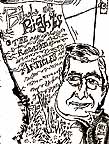
Bill of Rights up in flames?
|
 |
Bush's 'War' takes aim at those on the sexual margins
Thank goodness AIDS hit 20 years
before passage of the USA Patriot
Act-- the centerpiece of the Bush
administration's domestic "War on
Terrorism." Today, ACT UP is
remembered as the group whose
media-savvy,
in-your-face tactics forced America's
powers-that-be to address an
epidemic whose victims they were
content to let die. But if any future
ACT UP blocks traffic, invades
federal offices, and in the hurly-burly
of civil disobedience
accumulates raps for vandalism or
resisting arrest, US authorities could
pin on it a Scarlet T.
The USA Patriot Act, which
Bush signed into law October 26th,
allows the US for the first time to
designate domestic organizations as
"terrorist." At risk are groups such as
People for the Ethical Treatment of
Animals (PETA), Operation Rescue,
and the Vieques protesters. Once
certified "terrorist," a group's
members and supporters-- or those
thought to be-- will enter a
Kafkaesque legal netherworld. The
Patriot Act makes it a crime to
belong to a "terrorist" organization, or
provide it money or material support.
Any non-citizens living in the US
involved with such groups would face
stark consequences-- immediate
deportation, for example. Or, if a
country of
origin refused to take them back--
after all, America said they were
"terrorists"-- then the US could
imprison them
for life-- no need to prove any
crime.
If the prospects of a future
ACT UP/New York are dimmed, don't
expect an ACT UP/Toronto or ACT
UP/London to step into the breach.
Canada's parliament-- with
Washington's thumb pressing down
hard-- is set to
make protests like those in Quebec
City last April at the Summit of the
Americas-- subject to prosecution as
"terrorism" should they obstruct the
passage of a delegate. A new
Europe-wide arrest warrant,
approved in December,
covers terrorism, which the EU
proposes defining as offenses--
from "theft" on up-- aimed at
"seriously altering or destroying the
political, economic, or social
structures of a country." Greenpeace
Paris had better make sure its copy
of Microsoft Word is registered.
Political activists that Eurocops can't
lock up can be kept from travelling:
authorities say they are developing a
list of political troublemakers who
will be prohibited from entering
countries
where protest is brewing.
US authorities like the idea.
On November 1st, armed federal
agents grabbed Nancy Oden, Green
Party USA coordinating committee
member, at Bangor airport, and kept
her from flying to Chicago for a Green
Party conference. Longtime AIDS
activist and gadfly Michael Petrelis
won't be attending any
demonstrations soon. Claiming he
was a "terrorist" because of alleged
threatening phone calls, the San
Francsico DA locked him up,
together with Dave Pasquarelli, on
$500,000 bail-- far in excess of what
it would take to insure he'd show up
in court.
'Patriots' don't need
privacy
Judging by the response of
Western governments, the new
terrorist threat emanates not from
Osama bin Laden or Al Qaeda so
much as home-grown political
activists and dabblers in victimless
crimes of sex, drugs, and
ideas. The new legal regime taking
shape in the wake of September
11th smashes long-standing pillars
of civil liberty-- privacy, free
expression, right to organize,
freedom of movement, presumption
of innocence. These state's
new powers of surveillance,
imprisonment, and control are not
finely-aimed-- where they might be
justified-- at conspirators plotting
9/11-style attacks; they apply
generally to all police investigations.
In garden-variety sex and
drugs cases, the Patriot Act gives the
state extraordinary new powers-- with
no sunset provisions.
Electronic
surveillance. Police have long
had ready access to "pen registers"--
the list of the numbers dialed from a
particular phone. The new law
expands that access to allow police--
without any evidence
you've committed a crime-- to record
every move you make on the Internet.
In theory, the new data taps are like
"pen registers"-- only recording the
Web sites you visit and the
addresses of those you exchange
e-mail. But with a data
tap, it's up to the police themselves
to separate the URLs a person visits
and the addresses he e-mails from
the content he reads and writes.
Which is to say that, in reality, the
cops see everything and judges have
no power to object.
Secret searches
used to be allowed by courts in rare
cases. The Patriot Act makes the
exceptional routine-- and authorizes
police, in any criminal investigation,
to break into homes in order to copy
data files, bug
computers to record keystrokes and
catch passwords, and plant listening
devices.
Access to records.
The Patriot Act requires schools,
employers, banks, credit agencies,
and medical organizations to open
their files on demand to authorities,
without informing the individual
targeted.
As worrisome as these new
powers are by themselves is the
intent they share to free police and
prosecutors from judicial oversight.
Unlike ordinary search warrants,
police get Patriot Act data taps
automatically-- judges can't
reject them. With ordinary search
warrants, police specify what they're
looking for and where-- no peeking in
dresser drawers if the quarry is a
stolen car. Judges can punish cops
who overstep bounds, and
individuals
searched see the warrant and know
the score. But secret raids remove
limits on police snooping. Under the
Patriot Act, search warrants can have
national scope-- when a single
warrant authorizes dozens of raids
thousands of miles
apart, a judge can't assess how it
was carried out, and if it's not on his
turf, may well not care.
War on democracy
America's Constitutional
framers sought to keep branches of
government jealous of each other's
power in hopes of protecting
individuals' rights. But more than
upsetting the balance of powers, the
post-9/11 regime
makes an end-run around
democracy itself.
Exhibit A: the International
Convention on Cybercrime, hatched
quietly by the Council of Europe, and
unveiled in November. Set to be
ratified by countries around the
world-- including Canada, Israel,
Romania,
South Africa, and the US-- the treaty
requires signatories to agree to
standards for criminalizing hacking,
copyright violation, and porn. The
accord deputizes each country's
police to act as agents for the others,
to conduct raids on
each other's behalf, and to guarantee
"real-time surveillance" of suspects--
irrespective of a country's borders or
the rights previously secured by its
tradition or law.
"The Council of Europe in this
case has just been taken over by the
US Justice Department and is only
considering law-enforcement
demands," Dave Banisar, co-author
of
The Electronic Privacy Papers,
told
Wired. "They're using one
more international organization to
launder US policy."
But the treaty does more than
launder US policy-- it reaches over
the heads of even US courts and
lawmakers to impose American law
enforcement's wish list.
In October, the US Supreme
Court heard arguments in a case
challenging the constitutionality of a
federal law that extends draconian
kiddie-porn penalties to the creation
or possession of sexually-explicit
images in
which adult actors merely "appear" to
be under 18, and to purely imaginary
images that a court decides look
realistic. The justices needn't bother
drafting a decision, because the
Cybercrimes treaty turns the
"if-it-looks-like-a-minor,-it-is-a-minor"
standard into an international
obligation.
Last year, Canada's Supreme
Court-- a bastion of anti-porn
feminism-- nonetheless struck down
part of the national kiddie-porn law
prohibiting private possession. The
justices ruled that the ban, in at least
some
instances, came perilously close to
criminalizing thought. The
Cybercrime treaty throws that
decision away, establishing mere
possession on a computer as an
international offense.
Other treaty provisions
undercut constitutions and customs.
The treaty requires member states to
force citizens to divulge passwords--
a likely violation of the US
Constitution's protection against
self-incrimination.
Some predict the accord will sound
the death-knell for anonymous
re-mailers and other modes of
Internet identity- protection-- vital for
political activists and the sexually
marginal. In addition, the Cybercrime
convention will be
used to pressure Internet service
providers to log customers' usage
more thoroughly, so that anyone's
e-mails and web clicks will be readily
available in case the police in
Bucharest decide they need it.
Brave new world
Proponents of the USA Patriot
Act and the Cybercrimes treaty say
these measures are all about
securing freedom under changed
circumstances. But it's the freedom
of police and the powerful over
individuals or
communities that's being secured.
Sound familiar? The same
principle is at work in NAFTA, the
World Trade Organization, or the
General Agreement for Trade and
Services. These international
agreements allow giant
corporations, using secret
deliberative bodies accountable to
no one, to nix as "anticompetitive" a
country's environmental regulations,
labor codes, or standards of social
welfare. Anger over this democratic
usurpation fueled the
anti-globalization protests at
Seattle, Quebec City, and Genoa.
The AIDS movement similarly
focuses on how protection of
pharmaceutical firms' intellectual
property-- most of which in fact
developed with public resources--
now entails millions of
preventable deaths among the
world's impoverished.
The speed with which the new
clampdown has come, and its
irrelevance to the 9/11 attacks, reveal
that these measures were long in
gestation. September 11th was just
the excuse-- a chance to stifle the
anti-globalists
and further hot-up the wars on sex
and drugs that, in the West, are
sideshow distractions to the
corporate land-grab-- with 9/11 itself
the occasion for Bush to seek
hundreds of billions in tax rebates
and other corporate welfare.
If you're not for the military
tribunals and domestic spying, then
your with the terrorists, US Attorney
General John Ashcroft told
Congress. Ashcroft has won the
day-- the USA Patriot Act passed with
a lone dissenting
vote. The global police state
emerging in the wake of September
11th will hit countless people right at
home-- most of them involved in
victimless crimes of sex, drugs, and
politically unpopular expression.
More generally, the
new surveillance state inflames and
depletes the political landscape. In
response to unimagined crises to
come, vital movements the likes of
ACT UP will find it far harder to take
root and flourish.
You are not logged in.
No comments yet, but
click here to be the first to comment on this
News Slant!
|