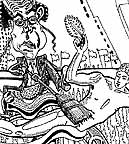
Prometheus’s fire damped
|
 |
Are New Yorkers' minds in for a rude spring cleaning?
By
Jim D'Entremont
Rudolph Giuliani, the Republican mayor whose reign has been dedicated to the Disneyfication of New York City, announced on April 4 the assembly of an advisory board intended to ensure that "decency" prevails at
city-funded cultural facilities. To create the panel, Giuliani revived New York's recently inactive Cultural Affairs Advisory Commission and redirected its mission toward censorship.
New York City now distributes an annual $115 million, $10 million more than the present budget of the National Endowment for the Arts (NEA), among cultural resources ranging from the Manhattan's Metropolitan
Museum to Staten Island's Snug Harbor Cultural Center. For many institutions, this support is indispensable. "The decency commission is a not-so-subtle warning to New York's cultural institutions that any expression deemed
offensive to Mayor Giuliani risks budgetary retribution," says Marjorie Heins, who heads the New York-based First Amendment Project.
The commission owes its existence to the mayor's vendetta with the Brooklyn Museum, which has managed to offend the mayor on two occasions. In 1999, Giuliani froze $7.2 million in funds earmarked for the
museum in response to Sensation, a group show for 42 young British artists, among them Chris Ofili, 33, an award-winning painter of African descent whose
"Holy Virgin Mary" depicts an African madonna dressed in swirling,
iridescent blue and green. Affixed to her right breast is a ball of dried elephant dung, one of Ofili's signature materials, emblematic of fecundity, nourishment, and African culture.
Sight unseen, Giuliani and his allies in the arch-reactionary Catholic League assumed that Ofili intended a fecal defilement of the Blessed Virgin. Branding the entire show "psychotic" in a stream of invective reminiscent
of 1930s Nazi vilifications of "degenerate" art, Giuliani sought to have the Brooklyn Museum shut down. He was soundly defeated in court; the museum's funds were restored. (Giuliani frequently winds up in court on
First Amendment grounds, and usually loses-- except, so far, in his increasingly draconian anti-pornography zoning schemes.)
The last straw for Giuliani was "Yo Mama's Last Supper," a five-panel composite photograph of a black Last Supper tableau. The artist, Renee Cox, appears in the center panel posed as Jesus, wearing only a shawl
draped over her shoulders. Cox, who uses religious imagery in much of her artwork, says her intent was to critique the Church's refusal to ordain women. The offending piece, which Giuliani branded "anti-Catholic" and "disgusting,"
was featured in a 94-photographer show that opened at the Brooklyn Museum in February in observance of Black History Month. Having previously failed to punish the museum by canceling its funding, the mayor sought a
new strategy.
The resulting 20-member moral-uplift board includes three artists, four lawyers, three clergymen, five corporate executives, a library trustee, a news producer, an NYU professor, the chairman of the New York City
Human Rights Commission, and an anti-crime activist. The two commission-members best known beyond the five boroughs are Curtis Sliwa, founder of the vigilantish, crime-fighting Guardian Angels, and Leonard Garment,
Richard Nixon's legal counsel during Watergate. One of the lawyers is attorney Raoul Felder, who is handling family-values-proponent Giuliani's pending divorce. A number of prominent New Yorkers declined to participate.
Apart from monitoring nasty sex and loathsome weirdness, the group is to keep tabs on material that defames or attacks religious. ethnic, or racial groups. (Presumably, this covers everything from Jewish stereotypes
in Renaissance painting to the song "Ugg-a-Wug" in
Peter Pan.) Giuliani's nod toward multiculturalism seems curiously hypocritical considering that his assaults on the Brooklyn Museum have targeted works by artists of
color whose output is steeped in African and African-American culture, but his vision of decency does have scope.
He expects that vision to be upheld in court. In 1990, as controversy raged over grants awarded by the NEA, especially to a retrospective exhibit of Robert Mapplethorpe's photographs, Congress passed legislation
requiring the NEA to consider "general standards of decency and respect for the diverse beliefs and values of the American public." The language was intended to warn artists to avoid religious or sexual material-- especially with
gay, lesbian, or feminist content. Legally challenged by four performance artists, the decency clause was struck down repeatedly by lower courts before being affirmed, more or less, by the US Supreme Court in its decidedly
odd NEA v. Finley ruling.
Giuliani is counting on the courts to apply
NEA v. Finley to the mission of his decency panel and find it constitutional. But he ignores the fact that in the 1998 ruling, an 8-1 majority of justices allowed the decency clause
to stand because they interpreted it as strictly advisory. Seven members of that majority held that the use of the decency language to penalize ideas would be constitutionally unacceptable.
How Giuliani's moral overseers plan to fulfill their mission remains to be seen. If the commission attempts to halt an exhibit or performance because of an artist's point of view-- an African interpretation of the Virgin
Mary, a feminist representation of Christ, a skeptic's take on organized religion, a gay man's celebration of homosexuality-- it will be stepping out of bounds.
"Government may refuse to fund all art work, or a particular category of art work," notes attorney Harvey Silverglate, a First Amendment specialist, "but there is a problem when the government seeks to exercise
viewpoint discrimination in deciding what to fund or not to fund"-- the outcome of
NEA v. Finley notwithstanding.
"There isn't going to be censorship. Paintings are not going to be torn down off the walls," Leonard Garment disingenuously insisted at the panel's inaugural press conference. The intent, in fact, is to frighten museums
into balking at the prospect of hanging certain paintings on those walls at all.
To achieve that goal, the commission needs to do little more than exist. "Ironically," observes Marjorie Heins, "it is the very uncertainty of the commission's powers and the vagueness of its mandate that will cast the
greatest chill over artistic engagement with politics, religion, sexuality, and other vital aspects of human life."
You are not logged in.
No comments yet, but
click here to be the first to comment on this
News Slant!
|