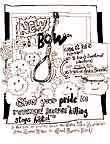
Human rights aren't gay rights...
|
 |
Now with free Lambda Gag!
Did the politics of hate-crime and a thirst for vengeance short-shrift justice in the trial of Aaron McKinney? On November 3rd, a Laramie jury convicted the
22-year-old roofer of second-degree murder and other charges, including some that subjected him to the death penalty, stemming from last year's beating death of gay University
of Wyoming student Matthew Shepard. No one, McKinney included, contests his role in the crime. But some gay activists and civil libertarians are now questioning
how Shepard's parents became key players in the trial, virtually dictating the plea bargain that short-circuited it after the jury's verdict. In a highly unusual deal,
McKinney gives up all rights to appeal his conviction and agrees that neither he nor his attorneys will ever publicly speak about the case. In exchange, McKinney avoids
execution, and receives two consecutive life terms without possibility of parole.
Aaron McKinney's trial was never about whether he killed Matthew Shepard. In his confession to police shortly after the murder, McKinney admitted that
he, together with Russell Henderson, picked up Shepard at a Laramie bar, went driving, and then beat him into a coma, leaving him tied onto a fence to die.
Henderson accepted a plea bargain last April that imposed two consecutive life sentences. The reason such a deal wasn't offered McKinney from the start was the desire
of Shepard's family to have McKinney executed-- an end never questioned by the anti-hate and gay rights groups that flocked to Laramie to spin news reporting of
the most notorious anti-gay crime in American history.
The death penalty is not a gay issue, insists the Human Rights Campaign, the most prominent of the organizations working the press in Laramie. The HRC
has repeated that position ever since the outcry over Matthew Shepard's murder raised the likelihood that prosecutors would seek capital punishment for his killers.
The HRC's stance puts it at odds with every major international organization with human rights in its mandate. But in fact, they, together with the Gay and Lesbian
Alliance Against Defamation, and various hate-crimes groups
were taking a stand on the death penalty by using McKinney's trial, whose
raison d'ętre was blood revenge, as a political soapbox in support of hate-crime laws.
Keeping Shepard's murder a "perfect" hate crime-- one based solely on Shepard's identity with nothing to do with sex-- was a concern paramount not only to the
gay and lesbian groups, but also to Albany County prosecutor Cal Rerucha, who hewed to the wishes of Shepard's parents. "At no time did Mr. Rerucha make any
decision on the outcome of this case without the permission of Judy and me," Matthew Shepard's father told the court at McKinnney's sentencing. "It was our decision to
take this case to trial just as it was our decision to accept the plea bargain today and the earlier plea bargain of Mr. Henderson."
Throughout the trial, Rerucha's legal strategy was to muzzle McKinney and his public defenders, who pleaded for the life of their client on grounds that
Shepard's killing was unplanned and committed in anger. McKinney had been coerced as a boy into homosexual activity by a neighborhood bully, his attorneys said, and he
flew off the handle at a sexual groping from Shepard. But DA Rerucha objected and Judge Barton Voigt agreed, disallowing the "gay panic" defense on the grounds
that Wyoming law makes no allowance for temporary insanity. The judge ruled, however, that factors affecting McKinney's state of mind could be introduced as an exculpatory
factor at a sentencing hearing.
Even though jurors only heard the "panic" defense adumbrated in opening arguments, they elected not to convict McKinney on premeditated murder-- a
strong signal they would not vote to execute in the trial's penalty phase. The Shepards' sudden consent to a plea bargain of life imprisonment at this point was less a
humanitarian gesture, as most media reported, than a realization they would fail to get the death sentence they sought. An arranged plea would allow them to dictate the terms,
and also avoid a sentencing hearing in which McKinney could once again claim that Shepard made a sexual approach.
There are reasons to doubt that Shepard made the moves on his killers, or that if he did, that's what provoked their violence. Only Shepard's murderers know
what happened, and they have little credibility and much reason to construct self-serving scenarios. However, these are matters juries are called upon to weigh.
McKinney deserved to put this evidence before the jury as part of his right to due process. The notion that Shepard's killing was not just murder but a "hate crime" also made
the question of Shepard's possible come-on crucial. The ideology of "hate crimes" demands abstract prejudice alone, and makes killing someone for making a pass a
less invalid reason for murder.
The Shepards' muzzling of McKinney was a terrible precedent, not only undermining his First Amendment rights, but the right of all of us to know more than
the Shepards' preferred version of the murder. Having lost the chance to deprive him of his life, the Shepards demanded a plea-bargain that muzzles McKinney's
humanity. One of the reasons for not killing evildoers is the potential everyone has to change and grow. If McKinney develops new perspective on his actions in the decades
to come, no one will share his insights. Yet such understanding would benefit all who care about preventing future anti-gay violence.
The state prosecutes criminal acts in the name of all the people, not just the wronged individual, his or her family, or a
particular community. Despite its flaws, the rule of law is universally preferred over the interminable feuding of rival clans that is typical in
the absence of central authority. But the ideology of "victims' rights" and "hate crimes" insists that impartiality and fairness are not
enough, that certain individuals and groups, and not others, require special privilege. That this is a step backward into clan conflict can be seen
in how the McKinney trial put the Shepards' private, perfectly understandable quest for honor and revenge at the center of a judicial
proceeding, where it did not belong. While these distortions served seemingly the side friendly to gay people and against those
violently hateful, the best safeguard for despised minorities-- and everyone-- is real justice.
You are not logged in.
No comments yet, but
click here to be the first to comment on this
News Slant!
|