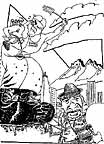
Kanada swats back
|
 |
By
Bill Andriette
His words got Robin Sharpe into trouble with
the law. Gay sex
stories he wrote that were seized from his home by
Vancouver vice
cops in 1996 led to the kiddie-porn charges
prosecutors laid against
him in 1999. But
Sharpe's words also helped get him out of trouble.
Defending himself
in a case that reached Canada's highest court,
Sharpe helped partly
knock down a Canadian law that comes close to
making thought a crime.
Over nine years, often serving as his own
lawyer, the retired
Vancouver city planner successfully challenged--
and in the end
slightly ameliorated-- one of Canada's harshest sex
laws, which can
put people in prison for
ten years for writing in their diaries, doodling in a
notebook, or
having the wrong novel on their shelves. Sharpe's
victory in British
Columbia's highest court, partly sustained by
Canada's Supreme Court
in 2002, rocked
Canadian politics and reverberates still. The case
turned Sharpe, now
70, into Canada's most prominent sex radical.
Last month, a Vancouver jury turned Robin
Sharpe into
Canada's most prominent sex criminal when it
convicted him of having
had consensual sex 20 years ago with a then-
teenager. (Canada
recognizes no statute
of limitations on crimes of desire.) Sharpe, once
again his own
attorney, claimed that the sex they had occurred
only after the youth
was of age. Prosecutors and the now-35-year-old
man asserted
otherwise, and then argued
that it didn't really matter, because Sharpe was in "a
position
of authority" for having lent the boy's mother
money. With his
sentencing set for July, authorities are preparing
finally to serve
Sharpe his cup of hemlock.
It all began in April 1995 with some marijuana
Sharpe unwisely had
in his luggage as he passed through US Customs in
Seattle on a flight
back from Amsterdam. US agents found it, and also
noticed some photos
showing
nude teenagers. Sharpe was let go, but the agents
passed the word on
to Canada Customs, who declared the nudes "kiddie
porn" and
seized them. A year-and-a-half later, vice cops
raided Sharpe's
Vancouver apartment taking
14 boxes of manuscripts, books, and photos.
When the cops came calling, there was
plenty for them to find
that they could add to the list of charges; more
porn writings,
pictures, and dope (Sharpe had thought to pay his
legal bills for the
case by growing
marijuana in his apartment). "If stupidity were a
capital
offense," says Sharpe of his second bust, "I would
be
dead."
When Canadian parliament rushed to pass a
kiddie-porn law in
1993, the Canadian Bar Association had criticized
the legislation as
overbroad. The law makes no distinctions among
photographic
depictions, stories,
political writing, or paintings. Nor does it
distinguish between
five-year-olds, youths of 17, or 25-year-olds who
merely "look
like" teenagers: all are criminal to
make, exchange, or possess. But it took Sharpe, a
retired city planner
to effectively challenge the law.
Sharpe had been published in gay
magazines such as
Passport and Sodomite Invasion
Review, a Canadian literary journal. His poems
and novellas are
variously crude, witty, sharp-edged, and poignant.
They are
"written
with a knife and an edge of wit," declares Shannon
Bell,
political science professor at York University in
Toronto, "the
closest one could get to touching de Sade, Bataille,
and
Burroughs." Whether his erotic stories start in a
prairie farmhouse, a Sultan's harem, or the post-
Armageddon wastes,
they often settle and linger on the theme of teenage
boys getting
whipped.
Vancouver sex police had another verdict on
Sharpe's oeuvre.
"The most horrific material I have had to deal with,"
Detective Noreen Waters declared-- a critical review
that Sharpe
today posts prominently on his
website (www.robinsharpe.org). Given that Sharpe
kept multiple copies
of all this vileness, prosecutors added a more
serious charge of
"intent to distribute."
Unable to find or afford a good lawyer
willing to fight the
charges, Sharpe made the bold decision to
represent himself at trial.
He studied the law, other cases, and then
formulated his legal
strategy. Not only would he
argue he wasn't guilty, he would argue the law
making possession of
child pornography illegal was itself unconstitutional
and should be
struck down.
Then shocking was result was that, in 1999,
British Columbia
Supreme Court Justice Duncan Shaw struck down
the Canadian
kiddie-porn law's possession provisions. What
people keep in their
homes is "an expression
of that person's essential self," Justice Duncan Shaw
declared
in his decision. "His or her books, diaries, pictures,
clothes,
and other personal things are intertwined with the
person's beliefs,
opinions, thoughts, and conscience."
Shaw's decision provoked a huge outcry.
Parliament threatened
to overturn the ruling by fiat, and anti-porn
crusaders collected
300,000 signatures.
In January 2001, Canada's highest court,
under extraordinary
pressure, mostly reversed Shaw's ruling on
possession-- though they
ruled that it was not illegal for an individual to
produce kiddie
porn-- i.e., write a diary
entry about themselves having sex as a 16-year-
old-- so long as he
didn't show it to anybody. As for the question of
whether Sharpe's
writings were illegal, the high court threw the
matter back to
British Columbia courts to
decide whether they had "artistic merit," a defense
under
the Canadian kiddie-porn law.
In March 2002, Justice Shaw acquitted
Sharpe on two, most
serious, charges of possessing pornographic stories
with the
intention to distribute-- the stories did not
"advocate or
counsel" illegal activity, and had
artistic merit, and so were doubly protected under
the Canada's
Charter of Rights and Freedoms, he ruled. (Sharpe
promptly published
some of them online at www.robinsharpe.org.) For
possessing illegal
pictures, Shaw gave
Sharpe a slap on the wrist-- four months of home
detention between
4pm and 8am. And that was a slap in the face to
Vancouver Vice, which
had obsessively pursued the case.
At the end of August, just before his
sentence was up, the
crown laid new charges. The evidence for the
crime? The very same
photos the Vancouver vice cops had held in their
possession since
1996, pictures on
which they had launched their initial prosecution.
The cops wanted to
use these photos as evidence that Sharpe was
having sex with one
particular teenage model.
The only trouble was-- despite years of
intense publicity--
they didn't have a complainant. Without a "victim"
the case
couldn't proceed. So Vancouver Vice put out a press
release--
disseminated nationally-- urging
the young man who Sharpe had photographed two
decades before to come
forward with an accusation.
And talk to the cops he did-- in an
interview the police
videotaped, Sharpe says the man talks fondly about
their friendship.
He also says that more than 20 years ago, when a
few years shy of the
age-of-consent, he
engaged in mutual masturbation with Sharpe and
got blow-jobs. Whether
the youth was of legal age was the point in dispute
at the trial this
March. The crown charged Sharpe under a 1971 law
of "indecent
assault of a male" and
"gross indecency"-- under the terms of which
Sharpe faces
up to 10 years in prison.
In response to the Sharpe case, Canada's
parliament has
passed bill C-12 to change the kiddie-porn law to
ax the
"artistic merit" defense for stories and pictures
depicting
youth sexuality, and to allow for the
prosecution of writers (or their readers) if fictional
characters
appear to be violating Canadian sex statutes. The
law further
broadens the kiddie-porn statute to cover all
writing "the
dominant character of which is the description, for
a
sexual purpose, of sexual activity with a person
under the age of 18
years."
In dictatorships and totalitarian regimes,
writers and
artists know they're in trouble if the reigning
powers decide, after
the fact, that a photograph, painting, essay, or
story does not-- the
phrase might be-- "serve the
public good." And that's precisely the standard that
bill C-12
proposes, in lieu of artistic merit, for the legality of
any
discussion or depiction-- real or imaginary-- of
child and adolescent
sexuality.
The proposed law directly threatens
probably thousands of
Canadians who perhaps own a copy of
100 Days of Sodom or a tape of
Bertolucci's
1900, but its provisions are pointed
directly at Sharpe. As author of
bawdy, sadistic, scatological, politically razor-edge
stories, Sharpe
is one part Aristophanes, the scaldingly satiric
Greek satiric
playwright. As alleged corrupter of youth,
questioner of sacred
truths, and nettler of moralistic
officialdom, he's one part Socrates. Now that
Canada gets set to
likely send its most notorious sex gadfly in prison,
it's worth
considering some of the writings that are the
authorities' real
reason for putting him there.
A Sharpe Sampler
J.D. Wannabe
Recollections of a misspent youth
When I was a kid I used to admire the boys who
got into trouble.
The bad boys were really something. I really wanted
to get into
trouble too but I was scared, and a sissy to boot.
Like they'd have
money, lots of money
sometimes, and I'd only just got my allowance
raised to a buck a
week. The bad kids had all sorts of neat things, like
radios and
dirty books, rings and neat shoes. They were always
going somewhere
and doing interesting things. And
the stories they told-- I believed all of them.
Actually I only heard
a few because the kids who were always getting
into trouble figured I
was a real asshole. But it wasn't just because I was a
sissy, some
them were too, but
because... Well, what really bothered me was that
they did mean
things, like stealing, and stupid things like getting
caught, and I
was such a good boy. I didn't like the idea of
hurting people, like
I'd had things stolen from me. I was
just a juvenile delinquent wannabe. Unfortunately I
didn't know about
status offenses at the time. I could have been
truant, unmanageable,
or promiscuous. Now that might have been a lot of
fun without hurting
anybody.
Timothy and the Terrorist
Excerpt from one of Sharpe's
prosecuted stories in which
"Young, innocent white boys sold as sex slaves to a
sadistic and
murderous sultan plot their own freedom and
overthrow a corrupt and
hated regime in the process."
Timothy trembling in a confusion of anger,
hate and fear examines
his welts. They're not serious, no cuts, no blood
and the pain is
subsiding.
"What's this all about? Who is that, that
weirdo?"
"Your master, he likes to decorate new
boys."
"But who is he?"
Old Tom smiles knowingly. "It is not to your
advantage
to know yet. But it is time for you to start learning
and training
for your new life. First you must always remember
to respect and
please your master whoever he
is. You must never refuse your master, it could
mean a whipping that
would maim you, or even your life. Come here and
lie across my
lap.... That's right. You must understand what your
master wants and
how to satisfy him. I
will show you.... Your asshole here, this is your
prize possession,
your organ of survival. Your master will want to
fuck it, fuck you,
fuck you repeatedly again and again, and he may
become rough and
violent in his passion. You
must prepare and train your asshole. Your lovely
pink asshole and,
mmmm I see, still tight little sphincter are going to
be subjected to
a lot of abuse, as they say. How much it hurts, and
whether you get
injured or torn, and I
know that really hurts, is mainly up to you. The
easier you can let
Master enter, and the quicker you can bring him
off, the better it is
for you....
Now, I've got some grease on my finger,
and as I push it in I
want you to try to alternately tighten and relax your
ring muscle....
That's it, that's the trick, but you'll learn to do much
better. Now,
you feel my finger
moving around? feel it reaching up by the base of
your spine? and
around and down here, this? that's your tiny
prostrate gland. If you
were older, you'd squirt semen when I squeeze it
like this.... Now
just relax, concentrate on
the sensation as I slide my finger in and out. If you
can get to like
or even tolerate that sensation, life will be much
more pleasant....
More grease.... Now this time I want you to wiggle
your hips up and
down as I shove my finger
in so you're doing half the work.... Good boy, good
boy, now make
your movements more rhythmical, like you're
dancing, maybe a slow
hula." The lesson continues for some time.
They hear a guard unlocking the double set
of steel doors and
two new men enter the gloomy corridor dragging a
bound and gagged
blond boy a bit taller and older than Timothy.
Old Tom looks up, "Two boys in one day is
highly
unusual, it's more like two a year. I'm sure Master
doesn't intend to
keep you both."
Again the guard gives the two men money
and they leave, but
as the boy is struggling he brings him into Tom's
room before untying
and ungagging him.
"Du verflucher, scheisswichser,
mongoloider,
Du!" The new boy continues to curse in
German.
Old Tom tries to reason with the lad but he
keeps on
struggling, cursing and kicking. Finally the two of
them strip the
German boy of his clothes and the guard handcuffs
him to a wall and
leaves going up the inside
stairs. Fairly soon the new boy's anger turns to fear,
his fine
features become distorted with despair and he
seems to be asking
questions they don't understand. His lean, tanned,
well muscled body
gauzed with the finest golden
hairs begins to sweat. Tom speaks reassuringly,
trying different
words but unable to get through. The lad has barely
settled down when
the hooded master and his two guards come down
the stairs....
Opium Wars
A brief history of Canadian drug laws
In the late 19th century, North America
addiction to opiates and
cocaine was probably higher than at any time since.
The addicts for
the most part were consumers of patent medicines,
very ordinary
people who were part
of the larger community. These medicines were
very effective in
relieving the pain and other symptoms of many
ailments and left the
user feeling pleasantly buzzed. Aside from a few
writers, poets and
artists there was
nothing resembling a drug subculture among white
people. The original
prohibitions targeted the "narcotics" in medicines
and
products like Coca-Cola. The law appeared to work
as the number of
users plummeted with relatively
little difficulty for those involved. It was almost as
easy as
legislating the lead out of gasoline.
It was only later in the early part of the 20th
century, when
there was a moral panic about "Chinamen" using
opium to
make sex slaves out of white women, that our
present approach to
drugs developed. Led by
Mackenzie King, who later became Canada's
longest-serving prime
minister, the Opium Act (which prohibited simple
possession-- an
unprecedented but largely unrecognized extension
of state power) was
enacted. The same coalition
of feminists and the religious who subsequently
successfully lobbied
for the prohibition of alcohol and pornography
vigorously backed the
law. It was another victory for women.
A subsequent panic, promoted by American
law enforcement
agencies and sensationalist media and also
endorsed by the same
coalition, goaded Parliament to prohibit add
marijuana without once
mentioning the "M"
word. The prohibition had little immediate effect in
Canada where the
drug was practically unknown but in the US there
was a massive
crackdown mainly on poor Mexicans and blacks. In
a massive crackdown
with tens of
thousands jailed and the prosperity the Second
World War brought,
marijuana usage declined barely surviving among
the marginal and
poor. It seemed to be a big victory for the forces of
rectitude....
Most heroin and cocaine users are not
addicts but enjoy the
high on weekends or whenever and know better
than to advertise their
habit. Because they have no rights as users they
cannot exercise
their voice. They
are not able to negotiate as gays have done. They
are like johns who
while having natural rights as clients to safety and
convenience,
they cannot represent their own interests in public
debate. In both
cases the costs of
expressing their views could be severe. It's hard to
make a case
without getting abused one way or another. This is
why druggies of
all sorts need rights. It is only through conversation
with those in
the market will we, including
the government, be able to resolve and end the
absurdity of the state
persecuting and degrading its own people and
subcultures in some low
intensity civil war. Drugs have to be legal in order
for related
problems to be
resolved. The medicalization of the problem
implicitly denies the
rights of the users who are officially seen as
consumers of therapy.
Mandatory treatment can be a cruel punishment
and with any
confidences being potential
evidence against you as well as unethical ones.
Ethics is often the
first casualty of zero tolerance. Sometimes I wonder
if those facing
mandatory treatment should be allowed to choose a
flogging as a more
honorable alternative.
Until the government starts treating drug users and
retailers,
prostitutes, and johns, and others as people with
rights they can
express without fear, and valid interests to defend,
there will be no
peace.
No Shit
Defecation gets better & better
When I was just a little kid hanging out at the
corner store I can
remember listening to old men talking about their
shits. It's true,
they're always talking about their shits, and I'd hear
them boast
about particularly good
ones though they usually didn't give all that many
details. And you
know what? They said they got better as you got
older. Every time I
saw a pensioner I used to wonder about it, but then
it was all pretty
remote and soon I had
the trials of puberty to deal with. Now 50 odd years
later I can
vouch for its truth, and you know something, shits
are particularly
good when you're stoned. It's best to have a big
meal several hours
earlier, I like lots of corn for
body and texture, and then you should hold off
until you feel you
can't wait much longer, but don't over do it, and
remember a passive
attitude towards the bowels, enhances the rush.
Don't grunt and try
to force things. Just
let it happen. At first I thought it might be some
sort of trade off
for declining prowess but it seems you can have
both worlds for a
while.
I should search the Internet to find out what
we're called.
There must be millions of us and at least a handful
of newsgroups. I
bet we've even got our own porn. I wonder what it's
like? We're not
coprophiliacs or
whatever, because we don't like to smear it, smell it
or eat it.
Personally, I would rank Thomas Crapper ahead of
Marconi or Mother
Theresa. Like we just get off on the shitting
sensation, it feels so
great, and leaves your anus glowing
for up to half an hour after. It's more fun than
politics and what
you see on TV. When you start pushing 70 you
don't really care
whether you used to be hetero or homo or even
which sex you are. You
Know where things are
at. The curious thing is that hardly anybody under
60 has the
slightest idea what we're talking about. I think we
should keep it
that way. We want to keep them working and
paying taxes for our
pensions. Just think if they
really knew. In their impatience they might miss out
on some of the
real delights of being in their fifties and even their
forties. And
then when they're about to lament their loss of
prowess a second
puberty pounces on them.
What a nice surprise! And the thrills of the new
sensations give us
something really worth talking about. But it's all
right for little
kids to listen in and believe the stories.
Surfing Dangers
Not all young swimmers drown
There's a popular assumption that bizarre and
obscene material is
harmful to children. In typical articles like, "Do you
know
where your kids are surfing?" and " How parents can
police
the Net" that appeared in the local
Vancouver press, concern is expressed about the
"safety" of
young people and advice is given on how to spy on
your kids and
control what they see on the Internet. Controlling is
equated with
caring. But aren't censorship programs
like Net Nanny and Surf Watch an affront to kids'
dignity and don't
they indicate a lack of trust, not a surfeit of caring.
Much of what
parents worry about kids may come across anyway.
Do parents know
what's out there
anyway? Do they know what they are afraid of? And
why? And should
they know, if only to better guide their children? Or
are parents
better off not knowing? People can feel truth about
things they fear
better in ignorance. But if
it's better to know than not, to know without
needing to imagine any
details, then what evidence is there that adults
would be any better
than adolescents in assessing it. Adults do not
learn as omnivorously
as young people
and they are much more ready to classify things.
The important question is not what
information kids may
encounter which may not be easy to control but
how they encounter and
deal with it which can be. Probably the best way for
a child or adolescent to
encounter problematic material is on their own.
Books are
an excellent source although they need to be
acquired and possibly
hidden on occasion. The privacy and anonymity of
the Internet is
ideal for discovering things on one's own.
He or she can read and view material and get into it
on the basis of
their preexisting understanding of the world and
free from the
pressures and expectations of peers, parents and
authorities. The
Net, unlike peers or
formal instruction, allows kids to chose the pace at
which they
acquire information. They can explore and then
retreat with a click
of the mouse if something freaks them out or their
parents are
coming. Kids need to guard their
privacy and be able to keep secrets. Keeping
secrets from parents and
authorities is a big step towards autonomy. The
parent in the article
offers advice on how spy on your teens to control
the information
they may find on the
Internet. It's all for the protection of children who
are not
considered morally or ethically competent to
experience certain
information.
But what about the children? Let us say a
12-year-old boy
comes across a site where a guy is holding his balls
in his hand and
extolling the joys of self castration, or maybe one
with a donkey
mounting a woman. If
he's gotten that far he's probably already read a
disclaimer, claimed
to be over 18 and selected categories. He has made
decisions and has
at least a vague idea of what to expect. Is viewing it
going to have
any significance
beyond his telling his friends about the real gross
stuff he's seen.
There are also a number of things that parents,
churches and schools
find difficult to discuss outside of official
propaganda or are
ignorant about but which kids
should learn about.
| Author Profile: Bill Andriette |
| Bill Andriette is features editor of
The Guide |
| Email: |
theguide@guidemag.com |
You are not logged in.
| # |
Subject |
Author |
Date/Time (ET) |
| 1254 |
Sharpe noticed |
tyciol
|
03/06/08 01:55 AM |
|