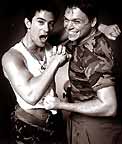
Soldiers at play
|
 |
Tomorrow's Israeli man?
By
Michael Bronski
Yossi and Jagger
directed by Eytan Fox
Hebrew with
subtitles
available 2004 from TLA
Releasing
How to order
Yossi and Jagger, which made the rounds of both the queer and the Jewish film festivals last year, has just been released on DVD and video, and is not-to-be-missed. This is a lovely
film: moving, surprising, and full of tenderness. Based on a true story, it tells of two men in the Israeli army who are lovers and whose love ends tragically in death. It's a contemporary
"Romeo and Romeo" in which both protagonists belong to the same family, but still face insurmountable barriers to happiness. It is also, in many ways, an anti-war movie that uses the
homoerotic love of comrades as a narrative through which to view the pointlessness of national aggression. But these are not the reasons that this is an important movie.
Yossi and Jagger is noteworthy not so much for its queer characters-- there have been other Israeli films with homosexual content, beginning with Amos Gutman's terrific 1983
Drifting. But here the characters are sexualized in a way that softens them, showing us a new aspect, a new potential, of Jewish masculinity.
When we think of Jewish men in contemporary films-- Adam Sandler, Ben Stiller, Adam Goldberg-- they're mostly comedians and neurotics; usually both. But Yossi and Jagger are
just regular guys in love. The scenes of the two frolicking in the snow, touching each other, and being generally playfully intimate are shocking not because they show us homosex in the
Israeli army, but because they suggest a gently erotic Israeli male persona.
It's been rare in Yiddish or Israeli film to see such images. There are two such scenes from Michal Waszynski's beautiful 1937 film
The Dybbuk. (See how far back we have to go!)
The first portrays Sender ben Henie (Moyshe Lipman) and Nison ben Rifke (Gershon Lamberger)-- the soon-to-be the fathers of the ill-fated romantic leads-- who are, in the truest
sense, soulmates. They love and live for one another. When we first see them they are praying and singing The Song of Songs together for their Rebbe. It is not a sexual scene, but it is
unforgettably loving and tender.
Later in the film there's a very brief scene of Channon (Leon Liebgold), the young male lover, in crisis about his love-life and dabbling in mysticism just before he kills himself. He
is shirtless, possibly nude, sitting in a rustic bathing house. As shot by Waszynski, he is both erotic and vulnerable. Again, this is a shocking scene-- unlike anything we've seen before in
Yiddish cinema, or since in Jewish film.
This is how the love scenes in Yossi and
Jagger hit us. They are striking for their original presentation of Jewish male emotional delicacy and openness.
There's been much recent writing about representations of maleness within Jewish traditions. Daniel Boyarin's wonderful
Unheroic Conduct: The Rise of Heterosexuality and
the Invention of the Jewish Man is a landmark book, offering a foundation for understanding the myriad, complicated ways Jewish men conceive of themselves and have been represented
in culture and art. Yossi and Jagger is an embodiment of those issues. It shows us new images of Jewish men that are-- in spite of, not because of their homosexual relationship--
startlingly new. It prompts us to question not so much the cultural taboos about same-sex desire or activity, but the many ways that being a man, being a Jewish man, might be different.
But Yossi and Jagger invites comparison with other films that deal with queerness and ethnicity. This is something that
Kiss Me, Guido did-- very badly-- but not
uninterestingly; especially when it concerned itself with the similarities between the social and dress styles of heterosexual Italian men and gay men in the East Village. A few years ago the film
Punks examined the lives of African-American gay men in Los Angeles. It wasn't a great film-- if far better than
Kiss Me Guido-- but it gave a fascinating look at how ethnicity and cultural
difference shape queerness. Yossi and
Jagger is short-- a scant 71 minutes-- but it is-near perfect for what it does.
| Author Profile: Michael Bronski |

|
Michael Bronski is the author of
Culture Clash: The Making of Gay
Sensibility and The Pleasure
Principle: Sex, Backlash, and the
Struggle for Gay Freedom. He writes
frequently on sex, books, movies, and
culture, and lives in Cambridge,
Massachusetts. |
| Email: |
mabronski@aol.com |
You are not logged in.
No comments yet, but
click here to be the first to comment on this
Movie Review!
|