|
 |
By
Jim D'Entremont
Aiming through a living room window at 3:00 a.m. on April 16, 2006-- Easter Sunday-- Stephen A. Marshall shot and killed Joseph Gray. The victim had been dozing on a couch at his home in Milo, Maine. Five hours
later, Marshall knocked on the door of William Elliot's vinyl-sided mobile home in Corinth, 24 miles away. When Elliot appeared, the 20-year-old assassin fired at point-blank range.
Moments later, when Ann Campbell found her boyfriend lying dead by the open door, his murderer still stood outside. Marshall stared at her, then returned to his father's silver pick-up truck and drove away.
Campbell wrote down the gunman's license number and called the police.
Marshall's vehicle was found behind a skating rink in nearby Bangor. Discarded bullets linked to his weapon were found in the men's room of the local bus terminal, where employees said the fugitive had boarded
a Vermont Transit coach bound for Boston. When officers surrounded the bus outside Boston's South Station, Marshall shot himself in the head with his father's .45-caliber handgun. He died a short time later at
Boston Medical Center.
The murders were vigilante strikes against registered sex offenders who were strangers to Marshall and to each other. Marshall had obtained their addresses through Maine's online sex offender registry. He was by
no means the first self-designated avenging angel to use such a resource.
His targets appear to have been picked for geographical availability, not for the specifics of their crimes. Elliot, 24, had confessed at age 20 to consensual sex with a girlfriend two weeks short of her 16th birthday.
Convicted of "sexual abuse of a minor," he completed a four-month sentence in Penobscot County Jail. Gray, 57, who in 1992 had been sentenced to a four-to-six-year prison term in Massachusetts for sexual contact
with a girl under 14, had recently been leading a circumspect existence with his wife.
Records found in Marshall's laptop suggested that during his lethal odyssey, the young vigilante may have visited four more residences where, for reasons unknown, he failed to act. At home in Nova Scotia, he
had combed through online sex-offender registries in at least three New England states. Prior to his murder spree, Marshall had requested detailed information on 34 individuals from the Maine Sex Offender Registry,
completing his research while visiting his father in Houlton, Maine, on the New Brunswick border.
The much-visited Maine Sex Offender Registry website, www.informe.org/sor, is browsable from link to link and searchable by name, zip code, city or town. The site provides mug shots of 2200 registrants, along
with their names, their dates of birth, the generally unenlightening legal terms for their crimes ("unlawful sexual contact," for example), and the names and addresses of their places of employment. Additional details,
including home addresses, mailing addresses, physical statistics, and expanded legal descriptions of crimes, are available to persons willing to provide their names and addresses. When Marshall asked for more data, he gave his
real name.
The online registries he visited fed and validated Stephen Marshall's longtime rage against anyone perceived to pose a threat to children. Although no evidence suggests that Marshall himself was ever molested
or attacked, he identified with children subjected to such treatment.
Born in Forth Worth, Texas, Marshall spent much of his childhood in Nova Scotia. His parents divorced when he was eight. At 13, he joined his father in Idaho, where he attended high school. He lived
uneventfully, except for an arrest for threatening another boy with a semi-automatic rifle. In his late teens, Marshall returned to Canada where, by the start of 2006, he was living in North Sydney, Nova Scotia, and working as
a restaurant dishwasher. He remained in contact with his father, who had moved to Maine.
A blog he started in Idaho, hosted by Anglefire, documented Marshall's adolescent obsessions: weapons, hockey, and sex offenders whose crimes involved children. Toronto's
Globe and Mail reports that he linked to a site called "How to Spot a Pedophile," and posted a list of suicide tips. His stated dislikes included "drag queens" and "gays." In his online journal, he ruminated about his life, quoted suicidal rocker Curt Cobain, and
railed against child molesters. The footer at the bottom of his homepage read, "Please email me, I'm lonely."
The Boston Globe called Marshall's motives a "mystery." Perhaps disingenuously, police investigators told reporters they could not imagine why Marshall would have murdered two men he had never met, but that
they were determined to find out. Their first order of business was to examine the contents of Marshall's computers.
They might have more profitably trained a spotlight on contemporary Western culture, especially that of the United States since 1975. Like the rest of his generation, Marshall grew up in a world primed for
readiness against the child-devouring Evil Other. He inhabited a universe of prurient scapegoating where, on the street, the
word abuse implies sexual misdeeds; where, in a court of law, a touch can morph into rape; and where,
in the minds of many, constitutional protections for the accused, once deemed inviolate, can be dropped to serve holy vengeance for crimes beyond the power of mainstream justice to address.
In the late 1970s and early '80s, inflated claims of atrocities against children served a backlash against sexual freedom; by the mid-'80s, they had become a function of AIDS-enhanced erotophobia. The
manufacture of sexual monsters has remained a staple of broadcast and print media since the late '70s, and, after the arrival of the internet, the
raison d'etre of countless websites. The Justice Department, politicians,
child-saving agencies sustained by public funds, and activists across the political spectrum have for years been milking attention, money, and power out of public fears for the safety of children. Their principal tools have been
paranoid rhetoric, junk science, and skewed statistics regarding sex crimes. (See box.)
No reliable data, including statistics produced by the Justice Department, indicates any substantial increase in child-abductions by strangers in recent decades. Figures on missing children typically include
known runaways and children abducted by parents. According to a January 2006 report by the National Center on Institutions and Alternatives (NCIA), "Juveniles are rarely victimized by strangers (7%)." Sex offenders,
thought to reoffend compulsively, have in fact the lowest recidivism rate of any class of criminal. In 2004, the Solicitor General of Canada measured the recidivism rate for child molestation at 12.7%; the US Bureau of
Justice Statistics recently found that three years after release, the recidivism rate for all sex offenders averaged 5.3%.
But strangers who perpetrate vicious sexual violence against children do exist. In 1989, it seemed to citizens of Washington State, where a cycle of sex crimes peaked with the genital mutilation of a
seven-year-old boy, that a plague of such people had entered their midst. The result was the Washington Community Protection Act of 1990.
The act created a Center for Sexual Predators, a bureaucracy charged with determining sexual dangerousness and whether or not an inmate will be civilly committed to a "treatment" facility after his criminal
sentence ends. It set up a sex-offender registry and made provisions for community notification of the identities and addresses of local sex offenders. Fervor surrounding its passage helped set the stage for the 1994
Wenatchee "sex ring" panic, in which 43 adults were rounded up on bogus charges of mass molestation.
By the 1990s, however, belief in vast conspiracies to molest, a signature delusion of the '80s, had begun to wane. Public attention focused on individual cases that were sometimes all too real; each case
spawned legislative remedies. The 1993 abduction and murder of 12-year-old Polly Klaas in Petaluma, California, helped inspire "three strikes and you're out" legislation imposing life sentences for even minor third offenses. A
year after Klaas's death, the California electorate approved a ballot initiative entitled "Keep Sexual Predators Off Our Streets," allowing judges to deny bail to anyone charged with felonious sexual assault.
Outrage reached critical mass in the summer of 1994, when 7-year-old Megan Kanka was raped and strangled by Jesse K. Timmendequas, a man who lived across the street from her home in Hamilton Township,
New Jersey. Timmendequas was a twice-convicted sex offender; the Kankas knew nothing of his history.
Local and national media fanned and exploited the anger unleashed by Megan Kanka's death. In New Jersey, a legislative package was rushed into law without hearings or even full development of its content, much
of it based on the Washington Community Protection Act. This original "Megan's Law" included provisions for registering and tracking sex offenders for ten years after their release, and for notifying area residents and
schools of the presence of sex offenders in a community. It also imposed a life term for a second sex conviction.
The Megan's Law model held wide appeal. The practice of registering sex offenders was not new, but prior to the Washington Community Protection Act, registration had been a tool of law enforcement,
typically shrouded in confidentiality, not a public resource.
In 1994, the US Congress passed the Jacob Wetterling Crimes Against Children and Sexually Violent Offender Registration Act, memorializing a missing Minnesota boy by making sex-offender registries a
federal requirement. In 1996, a federal crime bill amended the Wetterling Act to include a Megan's Law provision making community notification mandatory. This national version of Megan's Law did not, however, go as far as
New Jersey's law in demanding active, door-to-door notification of a sex offender's neighbors; it simply required the information to be made publicly accessible, a requirement for which it set no standard.
By 1999, all 50 states were in compliance with the federal Megan's Law. Sex-offender registries now exist in every state and US territory, with the exception of American Samoa. All state registries have to
some extent gone online. (A directory of registry web addresses is available at the FBI website, www.fbi.gov.) Community notification procedures range from supplying information upon written request to stuffing flyers
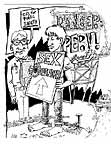
into mailboxes. Nineteen states aggressively disseminate sex-offender information by various means, including mailings, handouts, and posters. Five years ago, a Texas judge compelled 21 individuals to attach
"DANGER: Registered Sex Offender" signs to their houses and cars.
The contents of the registries vary from state to state, as do civil commitment policies, styles of treatment, gradations of supervision for released offenders, sex-crime statutes, interpretations of what
constitutes rape, and age-of-consent laws. A sex crime in California may not be one in Hawaii. A decade ago, the late William Elliot's transgression-- sex with a girl not quite 16-- would not have been a crime in Maine or
approximately seven other states, where the age of consent, later raised, remained 14.
Seventeen states practice "passive notification," requiring citizens to seek information on their own initiative. Some conservative states, such as Utah, dispense sex-offender information more guardedly than
states with "liberal" reputations, such as California and Massachusetts. California's Megan's Law website contains an astonishing array of data pertaining to 63,000 people, including 3,883 in Los Angeles and 628 in San Francisco.
California is one a number of states whose online sex offender registry provides maps pinpointing sex offenders' places of residence.
Many states rate sex offenders' dangerousness on a scale of three. Some, like Massachusetts, provide online data only for Level 3 offenders, those said to occasion the greatest concern. Maine provides data
on everyone, simply distinguishing registrants listed for ten years from those listed for life. Few registries make clear distinctions between homicidal serial rapists and people caught pissing in a gutter while drunk.
All the online registries carry disclaimers, some more pointed than others. Most states stress that sex-offender profiles are provided "for information only," and are not intended to facilitate forms of harassment
that are, after all, against the law. Such disclaimers offer meager comfort to the survivors of William Elliot, Joseph Gray, or two registered offenders similarly murdered last year in Whatcom County, Washington-- or to the
many others who have been taunted, hounded, run out of town, or injured during attacks.
Fear of vigilante justice drives some released offenders underground, including some who may actually merit monitoring. In other cases, it casts a pall over people attempting to be average, law-abiding citizens.
Paroled in 2003, former daycare worker Gerald Amirault, who has ceaselessly and credibly maintained his innocence, is listed as a Level 3 sex offender. The address of his home, where his family was targeted by
a drive-by sniper early in his incarceration, appears at the Massachusetts Sex Offender Registration Board website. Tim LeBlanc (not his real name) lost his video store job and had to sell his home after neighbors saw
him labeled online as a sex criminal. Other registrants recite litanies of harassment.
"I actually think [Megan's Law] is counter to public safety," says Boston attorney Rebecca Young, who regularly represents sex offenders at registry hearings. "Landlords discover they're renting to a sex
offender, and evict him; bosses find out they're employing a sex offender, and fire him; friends find out someone is a sex offender, and the friendship ends. What do we expect a homeless, unemployed, friendless former sex
offender to do? The registry closes off the avenues that lead to normal, healthy, productive lives."
In his book Moral Panic (1998), Philip Jenkins of the University of Pennsylvania points out that Megan's Law and its offspring place "offenders under a kind of community surveillance that [has] had few precedents
in Anglo-American law, at least not since the days when thieves, adulterers, and blasphemers were branded or otherwise mutilated in order that they be identifiable by their crimes."
But laws mandating sex-offender registration have resisted challenge. In 1999, an appellate court in Kansas found that forced registration of released sex offenders does not violate their right to privacy. In 2000,
the South Dakota Supreme Court found the state's sex-offender registration statute constitutional, denying that it piles more punishment onto a completed criminal sentence-- or, because vigilantism is illegal, that it
places registrants in any danger.
The US Supreme Court's first response to Megan's Law came in two separate rulings issued in March 2003. The court rejected 9-0 a claim that Connecticut violated due process by placing people on its
registry without hearings, and ruled 6-3 that released sex offenders in Alaska are not receiving additional punishment via registry requirements such as the posting of photos on the internet. "The purpose and the principal effect
of notification," Justice Anthony Kennedy wrote on behalf of the majority, "are to inform the public for its own safety, not to humiliate the offender."
It seems inconsequential to the Supreme Court that registration is experienced as punitive and humiliating by most registered sex offenders-- including Alden Baker, 56, who lives in a trailer at a secluded
location outside Boston, where he keeps the blinds drawn. "A lot of the time," he says, "I just hide."
Baker, who once operated a gay computer bulletin board, was released from prison in 2003 after serving a ten-year sentence for rape, plus 21 months in detention. The additional time was spent awaiting
civil proceedings demanded by a DA seeking his commitment as a "sexually dangerous person." Baker's "rape" was an ambiguously consensual encounter with his adult male chauffeur. (See
The Guide, May 2003.) Although his "victim" resurfaced to testify on his behalf at the civil trial where a jury set him free, Baker has been classed as a Level 2 sex offender.
The seven-member Massachusetts sex offender registry board had classified 8,774 persons as of January 31, 2006. Classifications are determined in hearings run by a hearing examiner; no member of the board
need be present. Rules of evidence do not apply. Only documentary evidence, including victims' impact statements, is supposed to be taken into account. But the registration process is highly politicized, and sensitive
to shifting, media-driven public obsessions.
"These registries," says Dr. Lenore Tiefer, associate professor of psychiatry at New York University, "are part of a moral panic against an already stigmatized population rather than a sensible policy initiative. As
with civil commitment laws, registries... result in the creation of an expensive apparatus which will suck money away from better programs, have no demonstrable effect on crime, and create an atmosphere of public fear
which can be easily manipulated."
"You can't turn on the TV without running into overheated bullshit about sex offenders," Al Baker points out.
Fox News is a fecund source of such material. John Walsh, father of young murder victim Adam Walsh, hosts its flagship rabble-rouser,
America's Most Wanted. "Sex abuse" is a favorite topic of talk-show
hosts, most persistently Oprah Winfrey, whose self-deifying website, www.oprah.com, is packed with information (how to "find registered sex offenders in your area") and misinformation ("at least one in twenty men are
child molesters"). Since September 2004,
NBC's Dateline has featured an ongoing series by reporter Chris Hansen that turns entrapment of men lured into meetings with nonexistent teenagers into a spectator sport.
On the internet, public fear is a merchandising opportunity. Child-protecting, crime-busting websites hawk books, recordings, videos, action kits, emergency whistles, caps, and T-shirts. At www.sexoffender.com,
one can purchase a "Code Amber Child ID and DNA Kit." The website of The Safety Company, thesafeside.com, sells videos, CDs, and other paraphernalia featuring the "Safe Side Superchick" who dispenses songs and
slogans intended to make children wary of strangers.
The sex offender industry thrives on non-profit status, however, drinking deeply from the public trough. A constellation of therapies and law-enforcement schemes, entirely or partially kept afloat by public funding,
has flourished in the wake of Megan's Law, despite cuts in essential human services.
Seeking votes, politicians keep sponsoring new legislative efforts to expand registration bureaucracies or increase penalties. Five states now impose the death penalty for certain sexual crimes against children. In
May 2006, Rep. F. James Sensenbrenner (R.-Wisconsin) introduced the Children's Safety and Violent Crime Reduction Act, one of whose provisions would expand sex offender notification requirements to surreal proportions.
"I have yet to see a single instance where anyone was ever protected by a sex offender registry," observes Rebecca Young, "but we sure are spending huge amounts of money on registering people."
Signs of sanity do surface on occasion, even among registration personnel. Utah's registry website asks for volunteers to help reacclimate released offenders to the community. The Oregon-based
SOhopeful International, a civil rights group founded in 1999, seeks "to dispel the myths, misinformation, and disinformation that been utilized to manipulate the public and hastily enact poorly thought-out legislation" regarding
sex offenders. The Society of Friends pursues humane approaches to released offenders, including "circles of support and accountability" recently applied with some success in Canada.
Prevailing currents nevertheless remain strong. In a 2004 poll conducted by SexCriminals.com, 81% of respondents answered
yes to the question, "Should private vigilante groups be allowed to conduct internet
sting operations to catch would-be child molesters?" Forty-three percent of those respondents felt that such vigilantes need not meet the same standards as law enforcement officials. (The poll was perhaps skewed by the
fact that many who are drawn to sites that deal with sex offenders are vigilantes themselves.)
"An attack is just one of those things that can happen," says Dan McManus (not his real name). "You can't keep looking over your shoulder. Nobody's one hundred per cent safe. Whoever you are, you can walk
into a McDonald's one day and some maniac can blow you away."
McManus, 44, a recently freed registrant whose entire criminal record concerns sex with a young teenaged boy when he was 20, works the night shift at a rural service station. He lives in New Hampshire, where
in 2004 Lawrence Trant pleaded guilty to attempted murder of two sex offenders whose addresses he obtained on the internet. ("I don't want people to steal the souls of little kids," Trant told a reporter.) McManus's
photo and home address are posted at the state's online registry.
Any post-vigilantism critical thinking is invariably short-lived. The contents of the New Hampshire registry were briefly scrutinized after Trant's rampage, then left unchanged. In the aftermath of Stephen A.
Marshall's killing spree, the Maine Sex Offender Registry was taken offline for a few days, then put back up without alteration. Protecting children, authorities agreed, trumps other concerns.
When he pulled the trigger of his .45 aboard the Bangor-to-Boston bus, Stephen Marshall blasted his head apart and spattered five passengers with tissue and blood. These included a nine-year-old boy in the
seat behind him. After trying to save children by murdering others, Marshall traumatized a child as he carried out the last of a series of gestures emblematic of his time.
You are not logged in.
No comments yet, but
click here to be the first to comment on this
Magazine Article!
|