|
 |
...Insides that whisper subversion
By
Michael Bronski
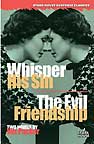
Whisper His Sin / The Evil Friendship
by Vin Packer (Marijane Meaker)
Stark House Suspense Classics
How to order
They were a lifeline on sale at drug stores and newsstands across the realm. Now one of the great treasure troves of queer history is the once very public, now mostly forgotten world of gay and lesbian pulps.
Sure, there are a few great collections of pulp cover art. And my 2003 anthology Pulp Friction: Uncovering the Golden Age of Gay Male Pulps (St. Martin's Griffin, 384 pages, $15.95) excerpted highlights from the genre. But savoring an entire pulp -- from lurid cover to lurid cover -- has been almost impossible. The combined rerelease of two of pulpmeister Vin Packer's best novels of the 1950s -- Whisper His Sin and The Evil Friendship (Stark House, 280 pages, $19.95) -- helps address the problem.
Marijane Meaker, writing under the pen name Vin Packer, had an amazing career. As Vin Packer she penned 14 pulps in the 1950s -- including the groundbreaking lesbian romance Spring Fire -- almost all of them excellent. She then wrote a few more traditional novels under that name, as well as four non-fiction paperback originals about lesbianism under the name Ann Aldrich. Later in the 1960s she published (under her own name) Shockproof Sidney Skate, a novel about a boy with two mothers. She then won prizes and high praise as a "young adult" novelist for books such as Dinky Hocker Shoots Smack. While these works are still available, her pulps have almost completely disappeared, which is why the publication of Whisper His Sin (first published in 1954) and The Evil Friendship (first published in 1958) is such an event.
The original pulp jacket copy for Whisper His Sin read:
This is one of the most shocking novels we have ever published. It deals with a strange way of life that has become all too prevalent, and is still spreading. The book begins in the tormented mind of a boy and ends in the tormented murder of his parents. Between this beginning and this end, there is a frightening picture of how the blight of sexual distortion spreads, corrupts, and finally destroys those around it. We also believe that this is one of the most morally enlightening books you will ever read.
This sums up the essence of pulp sensibility: titillating, alarming, dangerous, yet ultimately redemptive. Redemptive, that is, for the "normal" reader. But the trick of a great pulp novel is that while it faithfully ad-heres to these rules it also allows -- even invites -- an alternative reading.
Whisper His Sin -- based on the famous Fraden-Wepman murder case of 1951 -- tells the story of Paul Lasher, a psychotic college student who manipulates younger, insecure, and wealthy freshman Ferris Sullivan into murdering the latter's parents with cyanide-spiked champagne. The plot lights up the buttons of 1950s fears about homosexuality -- seduction, wealth, insanity, deception. In other hands, this material might simply reinforce already existing stereotypes, but Packer manages to introduce a subversive undercurrent that radically changes the novel. Rather then being anti-homosexual in its tone -- as the cover suggested -- Whisper His Sin becomes a novel about the destructiveness of society-abetted queer self-hate. Packer conjures the fear under which Ferris Sullivan lived: the gay-baiting at school, the mumblings that Sullivan will end up a suicide, the ominous chants of the school song "I want to be a Jackson man / 'cause a Jackson man's a goddamn fine man."
Packer's style careers between low-brow and high literary, and is far more adroit than most pulp writers. Whisper His Sin is a fragmented narrative, pieced together with police files, news reports, and snatches of popular song. She has a great eye for the details that conjure a time and a place.
While Packer had become famous in 1952 with the lesbian sorority-girl romance Spring Fire, most of her later novels were about crime, juvenile delinquents, and suburban adultery gone wrong. She returned to her lesbian themes in 1958 with The Evil Friendship, about two young women who kill one of their mothers. The novel draw on the noted 1954 Parker-Hume case in New Zealand. Like Law and Order, a great many of Packer's novels were "ripped from the headlines." (The Parker-Hume murder is also the basis for Peter Jackson's 1995 film Heavenly Creatures.) As in Whisper His Sin, Packer is concerned more with the social and cultural circumstances that lead to crime than the crime itself. This analysis is not just progressive for the 1950s, it's advance for our own time as well.
Packer is a great novelist whose works should be far better known and read. Stark House has issued these two queer pulps as well as double volumes of four of Packer's other works -- Something in the Shadows paired with Intimate Victims and Damnation of Adam Blessing paired with Alone at Night. All are terrific.
For steamy summer reading, these cool 1950s pulps promise to both entertain and illuminate a hidden past.
| Author Profile: Michael Bronski |

|
Michael Bronski is the author of
Culture Clash: The Making of Gay
Sensibility and The Pleasure
Principle: Sex, Backlash, and the
Struggle for Gay Freedom. He writes
frequently on sex, books, movies, and
culture, and lives in Cambridge,
Massachusetts. |
| Email: |
mabronski@aol.com |
You are not logged in.
No comments yet, but
click here to be the first to comment on this
Book Review!
|