|
 |
Eight Reasons
By
Bill Andriette
What could be wrong with making it a special crime to assault or kill someone because of their sexual orientation, race, or religion? In the wake of the murder last October of Matthew Shepard, the gay University of Wyoming student, more and more people are warming to the idea of hate-crime laws. Now on the books in 41 US states, these statutes variously multiply criminal charges or impose harsher penalties for crimes motivated by racial, ethnic, or religious bias. Of those states, 11 also include sexual orientation on the laundry list. Pressure grows to pass a national hate-crime law, allowing prosecution of bias-related offenses in federal courts, and to expand hate-crime statutes to cover sexual orientation, disability, and gender. It's hard to imagine a cause harder to oppose. Who could possibly stand for hate? Are there any reasons hate-crime laws are a bad idea? Here are eight.
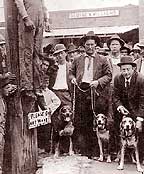
1) They distort our picture of crime Murder is terrible, as all societies recognize. Labeling a murder as a "hate crime" is gilding the lily. Rather than make the killing any more horrible, it demeans and distracts from its seriousness. The facts of a crime that qualify it legally as a "hate crime"-- the beliefs, language, identity, intentions of the accused-- are rarely grounded in solid, verifiable evidence. Yet that very insubstantiality means that more effort has to go into proving the "hate" than the underlying crime. This shifts the legal focus from the heart of the matter-- that a person has been beaten or murdered-- to the moral periphery. The more powerful hate-crime laws are, the more is at stake by proving or disproving the attacker's precise intentions, and the greater the distraction from the central crime. At the Nazi war-crime trials at Nuremberg after World War II, the judges argued that following orders was no defense for those collaborating in the Holocaust. Rather than shift the focus to verbose trivialities about exact intentions, the precise language of orders, and the chain of command, the judges' rule forced attention to fix on the horror of the deeds. The motivations and rationales for Hitler's minions were not on trial. Their actions were. Hate-crime statutes also distort by forcing crimes into their simple storyline of Satanic bigots and saintly victims. Is the Shepard murder solely about anti-gay hate? Even his attackers may not fully know. The two suspects are both economically-struggling Laramie youths who had dropped out of high school. Shepard was a well-to-do collegian educated in Switzerland with a taste for rough trade. The story is that the two men feigned erotic interest in Shepard, who was drunk. When he went off with them in their truck, they beat him with their gun, drove him to a remote field where he was tied spread-eagle to a fence, robbed, and left with his skull smashed. If class anger, convoluted erotics, and Shepard's risk-taking played a role in his murder, these factors don't remotely excuse the crime. But it is proponents of hate-crime laws who demand that a murder is "worse" depending on the precise constellation of victim and killer. Some murders are fired solely by bigotry. Shepard's is probably not one of them. By denying the potential complexity of motivations involved, we fail to grasp the reality of the crime, the lessons it may offer, and we fall into the trap of demonizing the malefactors whose lives, sadly, no major gay organization has urged should be spared. 2) Hate-crime laws pick the wrong target: bigotry, not violent acts Hate-crime laws punish people for prejudice that's incidental to a crime. They target speech and beliefs, not violence. To mean anything, the right to free expression must hold for those who believe or say things that the majority considers wrong, scandalous, or bigoted. Another pillar of a free society is the principle that people have no right to cause violence to others. Historically, both ideas are novel. In most places and times, strict censorship was the order of the day, and unequal protection from violence was built into law and custom-- lords could beat their serfs at whim, husbands their wives, parents their children. Modern democracies are unique in claiming to protect both free expression and equality. But hate-crime laws use the excuse of a crime to criminalize accompanying speech or beliefs. Proponents say that hate-crime laws don't punish expression, but only those bigoted intentions that motivate lawbreaking. The law, they point out, weighs a wrongdoer's intentions all the time. Certainly it's unjust to punish someone who accidentally kills as harshly as someone who plots a murder. But it's one thing to look at whether a violent act was intentional at all, and another matter to legally codify different punishments for different intentions. Most of us would regard more sympathetically a knife-wielding mugger who robs to buy milk for his baby, compared to one who robs to gamble. But no one, including proponents of hate-crime laws, suggests writing such distinctions into the statute books. A mugger's motivations might help discern the appropriate sentence after the fact. But it's another matter to inscribe as a general rule that certain reasons for mugging are more legitimate than others. From after the Civil War through World War II, mobs lynched thousands of people in the American South. The victims were overwhelmingly black men and youths accused of anything from murder to bumping into a white girl on the street. Victims would be seized by a mob, often from the local jail, and hanged, sometimes after prolonged torture. Southern editorial writers, when defending a lynching, often argued that a white person guilty of the same crime would deserve the same fate. Apologists cited the occasional lynchings of whites as proof the practice wasn't rooted in race hate. Even if we think they were deluded, these defenders of lynching use the same logic as advocates for hate-crime laws-- violence not rooted in prejudice, both contend, is somehow less serious. 3) They unfairly divide people Hate-crime laws divide society into unequal groups, giving special legal status and privilege to some. Hate laws impose extra penalties for assaulting people because they are Hispanic or Jewish, but not because they are overweight, anarchist, or boy-lovers. In deciding which kinds of people to include, lawmakers hold a beauty contest-- only those groups attractive or powerful enough make the grade. Hate-crime laws always include groups, such as Protestants, whose members are rarely targets for bias-motivated attack. They always exclude groups, such as illegal aliens and skinheads, that often are. In establishing that bigoted violence against certain kinds of people is a worse crime, these laws unavoidably make into a lesser crime violence against the others. Hate-crime laws force perverse discriminations among victims and defendants. A white person on trial for a hate offense for killing someone black would win his case by showing he murdered his victim for being an adulterer, an "acceptable" target. A prosecutor could not easily press hate charges against a black person overheard screaming "nigger" at the black man he was beating to a pulp. What about a gay man who during a spat throws a plate at his lover and calls him "faggot"? Is he guilty not only of domestic violence but a bias attack as well? If Wyoming had a hate law covering gay people, could Matthew Shepard's killers evade its penalties by contending that they were themselves-- as they may well be-- troubled homosexuals? Whatever the disputes about which groups deserve protection, hate-crime law proponents insist that extra penalties are only fair. When a crime is motivated by bias, they say, it is not just the immediate victim who suffers, but the entire group to which the victim belongs. A cross burnt on the lawn of one black family might as well be a cross burnt on the lawn of every black family in town, and deserves extra punishment to reflect that. But violent crime never affects just a single individual. A mugging in a neighborhood threatens all its residents. Matthew Shepard's murder was an offense not just against him, but his family, his friends, his countrymen, anyone with human feeling. The law recognizes this-- prosecutors take lawbreakers to court in the name of the entire citizenry, as in "The People v. Jane Smith." But hate-crime laws divide "the people" into rival factions, giving some of them special standing. This is a reversion to the anti-democratic principles that have historically ruled legal thinking. Under the Code of Hammurabi (1728-1686 B.C.), like most ancient legal systems, punishment depended on the status of the victim. If someone in the landowning elite broke the bone of a peer, his own bone would be broken in penalty. Breaking the bone of a commoner, however, required only a small payment of silver. Status distinctions like this continued into English common law, and were enshrined in the US Constitution's toleration of slavery. Only the 14th Amendment, enacted after the Civil War, officially granted equal protection under the law. Unequal privileges among groups in society breed resentment and hostility that can motivate violence. One of the best ways for dealing with people who act out from resentment is to be scrupulously fair to them. But hate-crime laws react to prejudice with unfairness. They can feed the vicious spiral of bigotry from which they claim to save us. 4) They're unnecessary Existing laws provide severe punishment for assault or murder. If these laws are applied when people are attacked because of bias, there is little danger those responsible will escape the consequences. Police, prosecutors, and juries do not routinely ignore today, as they have in the past, violence against minorities-- thanks to the political struggles of African-Americans, women, gay people, and others. But even if authorities did ignore violent bias crimes, hate-crime statutes would not be a remedy, for the choice to invoke these laws rests with the very same authorities derelict in their duties. If the state doesn't take seriously violence against gay people, hate-crime laws won't change the situation. If the state is doing its job and responds equally all victims of violence, then hate-crime laws aren't needed. Matthew Shepard is the mascot for a new anti-hate law initiative, but his case demonstrates why these laws aren't needed. Gay activists have had no beef with authorities' response to Shepard's killing. Police arrested suspects quickly on seemingly good evidence. Wyoming politicians vigorously condemned the killing. The two young men charged already face the death penalty. From whatever motives Shepard's killers acted, threat of further punishment would not have swayed them. Amidst the outrage and emotion, the greater danger is not that those responsible for Shepherd's murder won't be punished, but that they will not get a fair trial. 5) They allow double jeopardy Hate-crime laws give prosecutors a powerful new weapon. By labeling an illegal act a "hate crime," they can press additional charges or impose harsher punishments. This increases chances of winning conviction on the underlying charge. Or it can pressure defendants to cop a plea. If a defendant wins in court, anti-hate laws allow prosecutors to try a case again by bringing new "hate" charges. Once acquitted in state courts, defendants can be tried on federal "hate" charges. In some states, the addition of a hate-crime charge can be a third felony, subjecting a defendant to life in prison for a what may be a crime of minimal violence. As with the death penalty, hate-crime laws exaggerate the distortions and bias already present in the legal system against the poor and minorities. 6) They corrode freedom of speech The mere use of words like "faggot" or "nigger" in the course of a crime does not mean that "hate" is the motivation. And just because disparaging words are not uttered-- making bias hard to prove-- doesn't mean prejudice was not the motive. Hate-crime laws are a close cousin to regulations of so-called "hate speech." Theorists of "hate speech" contend that words disparaging to certain groups (but not others) are equivalent to violence and must be banned. That words and images are identical to violence is a favorite claim of contemporary censors. "Pornography is the theory, rape is the practice," goes the slogan of anti-sex feminists. In the same way, hate-crime laws make a lawbreaker's use of derogatory language proof that hate motivated the crime. But people use taboo words for all kinds of reasons-- or no reason at all. "Hate" words can even be expressions of affection or intimacy, because-- as with licking an asshole-- they can be a shared breaching of taboo. Hate-crime laws give the state the power to turn words into crimes without regard to the actual meaning of the people using them. Groups lobby to expand the state's power over speech because they think that power will only be used reasonably and for purposes they endorse. That almost never proves the case. Anti-porn feminists thought they won a victory for women when Canada's Supreme Court allowed censorship of sexual images "degrading" to women. But the first use of the law was to ban a lesbian sex magazine. Many among those first convicted under hate-crime laws are black, found guilty of racism toward white crime victims. Under anti-hate laws, ACT UP's demonstrations against the Catholic church's AIDS policies would be not merely controversial, but felonious. Freedom grows from granting the state less, not more, power to punish people for their beliefs and language. Freedom grows from protecting all people equally from violence. On both counts, hate-crime laws fail. 7) They create the illusion of doing something about anti-gay violence It's a long-standing American conceit: if there's a social problem, pass a law to solve it. The longer the prison sentences the new law imposes, the better the solution. The failure of these policies is evident in the ongoing drug war, which keeps America's prison population growing at staggering rates. One-third of black men in their 20s are in prison, on parole, or probation. The war on drugs has proven a model for crackdowns on "crimes" of consensual sex and pornography. With this track record, it's odd that proponents of hate-crime laws think the courts and prisons hold the solution to bias crimes. For years, activists have worked at the grassroots fighting violence against gay people: providing support and information to people attacked, noting patterns in violence, informing the community of dangers, pressuring police and prosecutors to see cases through to the end, and organizing community patrols. None of these practical and effective measures involves discriminating among people based on their identity, beliefs, or speech. Nor do they involve giving some groups special legal protection. Hate-crime laws give the illusion that we can off-load to the state work that we can only do ourselves-- a delusion politicians are happy to foster. 8) We seek hate-crime laws for questionable reasons An unspoken rationale why gays and other groups lobby for inclusion in hate-crime statutes is to advance our image, status, and power by winning official recognition from the state, to etch our identity into legal granite. Even without winning inclusion in them, just seeking hate-crime laws casts us in a favorable light. In contrast to right-wing rhetoric about gays as predators, we can present ourselves as victims. Countering an image as outlaws, we can join the popular clamor to "get tough" on criminals. The political lust for hate-crime laws mirrors that for gay marriage. For years, gay people have had the freedom to form one single life-long, monogamous relationship, but only a minuscule proportion of us do. Appearing to want the right to marry, however, is in part good public relations. The cynical hypocrisy underlying the push for hate-crime laws can be seen in the support of mainstream gay and lesbian groups, like the National Gay and Lesbian Task Force and Lambda Legal Defense, for sex-offender registries. From the standpoint of preventing violence against the sexually marginal, public registries of sex criminals are disastrous. It is hard to see what more the state could do to invite vigilante attacks and "hate crimes" than label certain individuals as "sexual predators," and then continually broadcast their names, pictures, and addresses for life. Since these laws have come into effect, registered sex offenders have had their homes burned down, been shot at, faced angry mobs, been run out of town, and driven to suicide. These laws disproportionately affect homosexuals, who are more frequently prosecuted for public sex and relationships with minors. From the logic of violence prevention, groups fighting for anti-hate laws should oppose sex-offender registries. From the logic of identity politics, however, these registries are a boon. They create a legally designated class of sexual demons whose position at the bottom of the food chain raises the status of identity-cleansed gays and lesbians. Sex-offender registries and hate-crime law are connected. They are both aspects of a broader process of involving the state in "managing" hate-- promoting it against the despised while making a show of "fighting" it against the privileged. A politician who expresses unctuous concern about hate while fostering politically rewarding social division seems analogous to a fireman who moonlights as an arsonist-for-hire. The ideals of equality before the law and the right to even odious expression may rub against the grain of identity politics, but in the end, these ideals aim for a higher good. Hate-crime laws seem like a quick fix to tragedies like the Shepard murder, but they short-circuit the justice of our cause. Especially for gay people, the choice should be clear: if hate-crime laws mean trading equality and freedom of expression for additional "protection" from the state, they are a bad deal. **
| Author Profile: Bill Andriette |
| Bill Andriette is features editor of
The Guide |
| Email: |
theguide@guidemag.com |
You are not logged in.
No comments yet, but
click here to be the first to comment on this
Magazine Article!
|