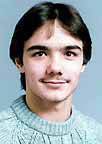
Bernard Baran in 1984, around the time of his arrest
|
 |
By
Jim D'Entremont
Being a gay teenager-- anytime, anywhere--
has never been easy. But few have paid as
terrible a price for their sexual orientation as
19-year-old Bernard Baran did in 1984.
Twenty years later, Baran is still paying that
price behind bars.
In October 2004, Bernard Baran passed
the 20th anniversary of his incarceration.
Two decades earlier, the openly gay,
19-year-old teacher's aide was arrested on
fictional charges of child rape. Sentenced to
three concurrent life terms, he remains
behind chain link and razor wire at an
institution for "sexually dangerous persons"
while lawyers
struggle to overturn his conviction. He has
now spent more than half his life in
correctional institutions. He has never had
an adult life outside prison.
Last June 16, Boston attorney John
Swomley walked into the Berkshire County
Courthouse in Pittsfield, Massachusetts, and
filed Baran's motion for a new trial. Bursting
with notes and appendices, the document is
the size of the Boston telephone directory.
The brief refutes previous "expert"
testimony and cites recantations by three of
Baran's alleged victims. It also identifies a
host of violations, lapses, and blunders in
Baran's January 1985 criminal trial:
ineffective assistance of counsel, suggestive
interviewing of
child witnesses, withholding and
mishandling of evidence, contempt for due
process, and misconduct by prosecutors
headed by Daniel A. Ford. An Assistant DA
in 1984-85, Ford is now a Superior Court
judge and one of the principal power
brokers of Berkshire County.
Written by appellate lawyer Pamela
Nicholson with input from Swomley, criminal
lawyer Harvey Silverglate, and other
attorneys, Baran's new trial motion took
nearly four years to complete. Its
development was hindered less by the
scope of the material than
by stonewalling on the part of two
successive Berkshire County District
Attorneys. As of this writing, evidence
pertinent to the politically sensitive case
remains missing.
Most documentation of the grand jury
session resulting in Baran's indictment, a
proceeding thought to be seriously flawed,
cannot be found. The law firm of Cain,
Hibbard, Myers & Cook, which handled
Baran's appeal, admits to having burned all
Baran records in
its possession, including material that may
have been unique. (Case files are legally
supposed to be kept for the life of the
inmate, but the exigencies of housekeeping
seem to have prevailed over legal niceties
at Cain, Hibbard.) Much of what the
attorneys have been seeking
is simply evidence that was or should have
been available to Baran's original attorney
at the time of his trial.
The Berkshire County DA's office
resisted cooperation for four years,
producing occasional tidbits at hearings
while finagling delays. Failing to obtain
access to case records through
conventional bureaucratic channels,
Swomley invoked the Freedom of
Information
Act (FOIA). When Acting DA David Capeless
turned down his FOIA petition, Swomley
filed suit.
Then, on September 14, Capeless
won the Democratic primary race for
Berkshire County DA, assuring his election
in November, when he would run
unopposed. The next day, the embryonic
District Attorney contacted Swomley with
news that a box of Baran evidence
had just happened to turn up. At a
September 17 court hearing, Capeless
relinquished four videotapes and a fragment
of grand jury minutes. To deflect a
potentially embarrassing lawsuit, the Acting
DA decided to comply with Swomley's FOIA
requests. Outside the
courtroom, Capeless invited Swomley to
view additional material at his office in late
October.
One year earlier, at a hearing that
would be his last court appearance in the
Baran case, Capeless's predecessor Gerard
Downing had surrendered, after 33 months
of wrangling, one eight-minute videotape--
edited down from its original 45 minutes--
depicting portions
of a therapist's interview with one child.
(Three girls and three boys, aged three to
five, were named in the case.) Downing,
who had insisted upon keeping taped
interviews under wraps to protect the
children's privacy, admitted that the
videocassette had just been retrieved
from the apartment of a former colleague
who had brought it home to use as a visual
aid in training interrogators.
Perhaps impatient with Downing's
pattern of stalling and equivocation, Judge
Francis Fecteau granted Baran's legal team
a degree of subpoena power unusual in
criminal cases. Swomley immediately
subpoenaed records from an array of law
firms and agencies
holding various pieces of the Baran puzzle--
police notes, health records, more taped
interviews, other pertinent data. Progress, it
seemed, was at last being made.
More obstacles arose, however, in
December 2003, when Downing suffered a
fatal heart attack. Named as Downing's
replacement, David Capeless pointedly
avoided the Baran case for several months.
During that time and at present, the
gatekeeper of paperwork
and communications emanating from both
sides has been Berkshire County Clerk of
Court Deborah Capeless, David's sister-in-
law, who has routinely expedited the DA's
procedural business while setting up
bureaucratic roadblocks for Baran's defense
team.
Meanwhile, lawyers on both sides of
civil suits filed by parents after Baran's
conviction agreed to turn over documents,
but only if explicitly directed to do so by a
judge. The Massachusetts Department of
Social Services consented to provide files
under similar
conditions. Judge Fecteau issued the
appropriate orders in late September. Much
of this material-- caches of documents,
audiotapes, and videotapes-- has already
been handed over to Swomley and is being
examined.
Eye on the prize
The identifying contents of the newly
obtained videotapes are sealed by a
protective order. It is known, however, that
most of the tapes are unedited. Comparison
with unedited tapes and transcripts show
that the edited versions omit leading
questions, pressure
tactics, and incentives for "right" answers.
Untrained interviewers used "anatomically
correct" dolls, a practice now considered
forensically worthless and ethically
questionable.
The videos show information being
manufactured. One child whines, "When do I
get my prize?" A second child is far more
interested in playing with a toy truck than in
the penis-equipped doll his inquisitor keeps
thrusting at him. A third cannot remember
what she
is supposed to say until her mother
intervenes and walks her through the
scenario they developed at home.
Baran was indicted by a grand jury
whose members were shown what Swomley
describes as a "compilation of naughty bits"-
- a series of heavily edited selections from
videotaped child interviews. "Scientific"
evidence amounted to little more than a
local
pediatrician's belief, since discredited, that
one girl's normal vaginal irregularities might
have resulted from penetration by adult
fingers or a penis. There was also the matter
of another child's positive gonorrhea test.
But as long as grand jury records remain
missing, no one will
fully understand the logic behind Baran's
indictment on five counts of rape and five
counts of indecent assault and battery. (A
sixth count was inserted before the case
was tried.)
Truth filters
What happened at Baran's seven-day
trial is, by contrast, all too clear. Courtroom
rehearsals began for the children six weeks
before criminal proceedings got underway.
But at a preliminary competency hearing,
the parade of child witnesses failed to show
they knew
fact from fiction. At the actual trial, the
children were not placed under oath, but
asked, "Do you promise to tell what
happened?" They were seated on the floor
below the lawyers' table, where Baran could
not see or hear them, and they could not see
Baran. Their testimony
was devoid of content whenever it strayed
from canned statements. Assistant DA Ford
attributed their reticence to fear.
Paul Heath, the first accusing child,
denied being abused and responded to
most questions with obscenities or silence.
He was subsequently dropped from the
case. The prosecution's references to this
boy in closing arguments were permitted by
Judge William Simons
and left unchallenged by Baran's defense
counsel, Leonard Conway. Hired on a $500
retainer, Conway let breaches of due
process slide by without comment.
Hearsay testimony and innuendo
were freely allowed. When Ford brought in a
physician to assure jurors that gay men
were a principal source of gonorrhea, the
Heath boy's positive gonorrhea test trumped
Baran's negative test result. Ford
hypothesized that Baran
must have cured his own venereal infection
on the sly, dismissing Baran's allergy to
penicillin. Ford portrayed Baran to the jury
as a diseased, predatory
untermensch who prowled the gay
bars of nearby Albany, New York, by night
and spent his work days at the preschool
acting
"like a chocoholic in a candy store."
Sing for your skin
After the prosecution rested its case,
Ford offered Baran, for the third and final
time, five years' detention in minimum
security in exchange for a guilty plea.
Insisting on his innocence, Baran refused to
comply. When the jury found him guilty on
all counts, Judge
Simons remanded the slightly built,
asthmatic teenager to the maximum security
prison at Cedar Junction, a repository for
violent felons. Four days later, Baran
sustained the first of many rapes.
Baran's mother and his then-
boyfriend raised $10,000 for an appeal,
turning to the most prestigious law firm in
Berkshire County-- Cain, Hibbard, Myers &
Cook. They did not know that immediately
after Baran's sentencing, the mother of one
of the alleged victims
had retained Cain, Hibbard to begin the
process of suing ECDC for $750,000. Cain,
Hibbard attorney David O. Burbank's
signature appears on letters written in early
February 1985 to Daniel Ford and a local
pediatrician, requesting Baran evidence.
Although the child's mother
later changed lawyers, her lawsuit, one of
three, resulted in a modest out-of-court
settlement that included a small payment to
Cain, Hibbard for its services.
Eight months later, Burbank, who
never disclosed his prior involvement with
the ECDC lawsuit, worked on Baran's
pro forma appeal. At some
undetermined point following the failure of
that appeal in 1986, Cain, Hibbard
employees illegally destroyed the firm's
Baran file.
(It is worth noting that ex-prosecutor
Daniel Ford joined Cain, Hibbard in 1987
and remained there until his judicial
appointment in 1989.)
Shunted from prison to prison,
frequently brutalized, Baran grew
increasingly despondent. In 1988, he
slashed his wrists. Following this episode,
he was sent for evaluation to the Treatment
Center for Sexually Dangerous Persons at
Bridgewater, Massachusetts, a
facility then under the aegis of the
Department of Mental Health. Seeking a
safer environment, Baran submitted to a
psychiatric interview that secured his civil
commitment to the Treatment Center. Baran
insists he has never admitted guilt, but his
placement at the Treatment
Center is predicated on an alleged
confession of culpability.
In the early '90s, the Baran case
reached a turning point when Jocelyn
Sedney, an attorney representing ECDC's
insurer, conducted an investigation. Sedney
learned that at least one of Baran's alleged
victims had recanted to a therapist, and that
the information had
been withheld from Baran's defense
counsel. There are now known to have been
three recantations, most recently in the late
'90s when one of the children, then a
teenager, told a class about obtaining
money in a lawsuit after having falsely
accused a gay teacher of
sexually assaulting him.
Sedney also learned that Paul Heath,
the boy who tested positive for gonorrhea
(according to a test now known to be
unreliable), had made a relatively credible
disclosure of sexual contact with one of his
mother's boyfriends. The disclosure
occurred in January
1985, and was substantiated as jury
selection began for Baran's trial. The DSS
report revealing the allegation, never acted
upon, was apparently withheld by the DA's
office until after Baran's trial had ended.
Sedney referred the case to a lawyer
who accepted it
pro bono but never attempted to
move it forward. Sedney's discoveries went
nowhere until 1999, when John Swomley
initiated a new trial motion.
Baran now works as a baker in the
Treatment Center's staff kitchen. Therapists
there have agreed that he shows no
evidence of sexual attraction to small
children. Dr. Barbara Schwartz, longtime
director of treatment at Bridgewater until
2002, has supplied
Baran's lawyers with an affidavit stating her
belief in his innocence.
DA Capeless requested and received
120 days to review Baran's new trial motion.
On October 26, he presented Swomley and
Judge Fecteau with a 27-page written
response that relies heavily on precedents
set during another, equally dubious
Massachusetts
daycare case. (See box.) Judge Fecteau will
begin hearing arguments for and against a
new trial on December 28.
The case is being heard in
Worcester, a city closer to Boston than to
Pittsfield. Judges in Berkshire County
recused themselves from the case because
it involves Judge Daniel A. Ford. A devout
Catholic who is tough on sexual
transgressors, Ford is also a lifelong
bachelor who turns up at theatres and
restaurants with younger men who seem to
be his dates. He is widely perceived as gay.
If Baran is granted a new trial, Ford has a
great deal to lose, both personally and
professionally. Behind Capeless looms the
specter of Ford.
Despite progress in the case, Baran
finds optimism hard to sustain. "The support
I'm getting brings me hope," he says, "but
people want me to trust the system that
convicted me. I've been around that system
for too long to be sure we can win. It's hard
to let
myself feel good about anything. It's like I've
got this dark spot inside and it keeps getting
ready to grow and engulf me. If we lose, it
will feel like being sentenced all over again.
I don't know how I can live through that."
For more info about the Baran
case, visit the Bernard Baran Justice
Committee, www.freebaran.org.
You are not logged in.
No comments yet, but
click here to be the first to comment on this
Magazine Article!
|