|
 |
1950s Hollywood was straight only on the outside
By
Michael Bronski
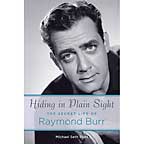
Hiding in Plain Sight: The Secret Life of Raymond Burr
by Michael Seth Starr
Applause Theatre and Cinema Books
How to order
Contrary to its Leave it to Beaver and
Father Knows Best reputation, the 1950s was a complicated time in which queerness held an intrinsic place. Sure,
aspects of the decade were sexually repressive and conformist. But then how do we explain Little Richard, Liberace, the openly gay themes in
Rebel Without a Cause, all those lesbian and gay pulp novels, and the first U.S. gay rights groups with any traction (the Mattachine Society and Daughters of Bilitis)? Sounds pretty gay
to me.
C
ertainly one place we might look at to discover more of the "queer fifties" is Hollywood. Consider the campy-serious melodramas of Douglas Sirk, such as
All That Heaven Allows; Russ Tamblyn in Tom Thumb
(the gayest children's film of the decade); the singing, shirtless sailors in
South Pacific; the queerly coded Bell,
Book, and Candle; the flamboyant Anthony Perkins in anything; all of those films based on Tennessee Williams plays (especially
Suddenly, Last Summer); anything with the post-Mildred Pierce Joan Crawford, especially
Queen Bee; Alfred Hitchcock's Rope and
Strangers on a Train; and a whole host of teen-horror films such as
I Was Teenage Frankenstein and How to Make a
Monster. Queer in Hollywood was no secret.
Until recently we've lacked a clear sense from insiders about 1950s queer Hollywood. Michael Seth Starr's
Hiding in Plain Sight: The Secret Life of Raymond
Burr (Applause Theatre and Cinema Books, 268 pages,
$24.95) is the latest of a series of books over the past three years filling
this gap, showing us how central homosexuality -- and gays and lesbians on the scene -- were to what Hollywood did and how it understood itself.
Hiding in Plain Sight has some great material, and is written well enough. Burr is that curious Hollywood type: extraordinarily famous, yet -- because he is
a character actor -- essentially unknown as a person to his audience. Starting out as a "heavy" in crime and thriller films, Burr took a chance in 1957 to play
Perry Mason in a new TV show based on the famous character of book, movie, and radio fame. The show was a hit, and Burr became world famous as the
clever detective. But since he wasn't a romantic lead, no one was really interested in his personal life. This was convenient, since Burr was not particularly closeted.
Sure, he'd been married when young, a fact he frequently referenced. But he lived for most of his adult life with his lover Robert Benevides, a struggling actor
who became Burr's manager, business partner, and very longtime companion.
If Burr's life had been more fascinating, Starr's biography would be also. Except for a brush with a semi-outing in
Confidential magazine in April 1961 (leading
to an FBI investigation), the actor's life was mostly hard work and long hours on the set. But without the distraction of flashy anecdote, Starr conveys a
broader sense of what it was like to be a gay actor in the Hollywood of the period.
Hiding in Plain Sight nestles comfortably on the bookshelf with similar books published recently. Farley Granger's 2008 autobiography,
Include Me Out: My Life from Goldwyn to
Broadway, though superficial, chronicled a life far more interesting than Burr's. Granger was connected to progressives who faced the
McCarthy blacklist, he "dated" Shelly Winters, was a sex symbol, went to Italy to make films with Luchino Visconti, and also worked on Broadway.
Even better is Tab Hunter's 2005 autobiography
Tab Hunter Confidential: The Making of Movie
Star. Smartly written and filled with telling detail,
Hunter's autobiography gets to the heart of what it meant to be gay, sort-of-out-and-sort-of-closeted, and in the middle of Hollywood media hysteria. Hunter was the
real thing -- a star with mass appeal based on sexual magnetism and popular with teenaged girls as well as older women. Tab Hunter is both personally forthcoming
and analytical, conveying a rich picture of Hollywood gay life as well as how it interfaced with the machinery of stardom and publicity.
What becomes clear through these books is how Hollywood was organized around producing personalities -- of a wide variety -- and allowing actors to
maintain their own personal lives even as the studios were manufacturing for them false ones. At the height of his career, Raymond Burr had one real ex-wife, and also
two dead ones as well as a dead son who were all fictional. The "closet" certainly existed in 1950s Hollywood, but it was constructed to be roomy, invisible, and
with a swinging door.
| Author Profile: Michael Bronski |

|
Michael Bronski is the author of
Culture Clash: The Making of Gay
Sensibility and The Pleasure
Principle: Sex, Backlash, and the
Struggle for Gay Freedom. He writes
frequently on sex, books, movies, and
culture, and lives in Cambridge,
Massachusetts. |
| Email: |
mabronski@aol.com |
You are not logged in.
No comments yet, but
click here to be the first to comment on this
Book Review!
|