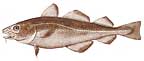
Etymology bags a fishy quarry
By
Blanche Poubelle
Many readers of The Guide will have read about a controversy concerning the children's book
The Power of Lucky. The New York
Times recently reported that this book has been banned from a few school libraries because
it dares to use the word scrotum. The offending word arises when the main character, Lucky, hears a neighbor talking about a dog bitten on the scrotum by a rattlesnake. A librarian from Colorado was quoted as saying that
words for male genitalia do not appear in quality literature.
It is Blanche's guess that the issue is not really so controversial-- the great majority of librarians and readers have no problem with the book or the word. And it seems that the few librarians who have refused to purchase it
have no personal objection, but are nervous about complaints from parents.
What interested Miss Poubelle more was a puzzle about the word itself.
Scrotum is a very odd sounding word, and the
-um ending is a clear indication of a Latin borrowing.
Scrotum is first attested in English in 1597 in a
medical vocabulary, and the term was judged unfamiliar enough to merit a definition-- "The Scrotum, which we call the bagg wherin the testicles are contayned."
English has a complex history-- much of our core vocabulary comes from a Germanic, Anglo-Saxon source. But since the Norman Conquest and the Renaissance, English has also borrowed large numbers of Latin and French
words. The Anglo-Saxon words are often the most basic terms, while French and Latin words are considered more refined or polite.
When it comes to the body and its functions, Latin words are generally considered more appropriate for medical discussion. These Latin words are often paired in English with Anglo-Saxon counterparts, which are
considered vulgar. So feces, anus, and
vagina are Latin; shit, asshole, and
cunt are Anglo-Saxon. We copulate in Latin, but we
fuck in Anglo-Saxon. There's also a good generalization that if we have only one name for a body part (e.g.
head, arm, foot, mouth, tooth), that word comes from Anglo-Saxon.
When there are two words, we use the difference to good effect in English-- switching from one word to another sends a clear signal about social register. So the scrotum puzzle is as follows-- if
scrotum is the polite Latin word, what is the Anglo-Saxon equivalent?
We can think of other possible terms for the scrotum, such as
nut sack, where both parts are present in Old English. But a look through the historical sources shows that nut for "testicle" is not attested till the 19th
century. So what was the English word before
scrotum was borrowed in the 16th century?
The answer might be the now obsolete term cod.
Cod is an old word for "bag," and from ancient times it has also referred to that favorite of bags, the scrotum. It survives in modern spoken English only in the term
codpiece, which is a piece of fabric that covers the cod.
The first recorded instances of cod referring to the scrotum are from the 14th century, and in 1527 one distillery listed among its wares a drink "good for a mannes yarde or coddes" [that is, good for a man's penis or
scrotum]. Cod also has had some frequency as a term for the casing that encloses seeds, as when a 1597 description of a particular herb said that "The seedes are conteined in square cods."
So perhaps what we have in English is the unusual situation where the polite, Latinate word
scrotum has completely displaced the older, presumably impolite Anglo-Saxon word
cod. This would be a puzzling case where we
have a body part with no Anglo-Saxon name.
But there is another way of thinking about the scrotum puzzle. In ordinary English, a word like
balls (or British bollocks) is generally ambiguous between the two senses. In "He licked my hairy balls,"
balls means "scrotum." In "I have two balls," it means "testicles." Also notice that
balls is normally plural, even when it refers to one scrotum.
This is probably because we normally talk and think of balls/testicles as both the internal organs and the skin that covers them. It is only in a few unusual contexts that something affects one but not the other. (You may
choose to have your scrotum pierced, but Blanche hopes that you will not do that to your testicles.)
Rather than thinking of scrotum as a Latinate word with no currently used Anglo-Saxon counterpart, the best answer to the scrotum puzzle is to say that
testicle and scrotum both correspond to a single Anglo-Saxon word,
balls/bollocks. The etymological question yields a solution. But figuring out why some librarians and teachers are so reticent to mention this body part is a puzzle beyond Blanche's abilities.
You are not logged in.
No comments yet, but
click here to be the first to comment on this
Loose Lips!
|





 Advertise with us
Subscriptions
Contact us
Site map
Translate
Advertise with us
Subscriptions
Contact us
Site map
Translate