|
 |
The gay Beats
By
Michael Bronski
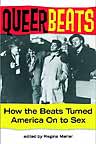
Queer Beats: How the Beats Turned American On To Sex
edited by Regina Marler
Cleis Press
How to order
The reality of the Beat revolution has become distorted. One of the most salient misconceptions is that the "beats"-- really, a quite small group of innovative thinkers, writers, and
artists-- were identical to that large amorphous group known as "beatniks." In actuality, "beatniks"-- the word itself was coined by San Francesco columnist Herb Caen in 1958 after the
Russians launched Sputnik-- was a general, dismissive, term used by the media to describe not just the real "Beats" but a wider group of people perceived to embody a range of anti-social
affects. Under this rubric, anyone who liked abstract art, read (or wrote) contemporary poetry, wore black clothes, had an interest in Eastern religions, or lived in Greenwich Village or North
Beach was a beatnik
The second popular misconception was the Beats were all social outcasts who scorned American culture. While this is partly true-- the Beats rejected standard-issue American
1950s mores-- they were potent critics and visionaries. Many saw themselves as consciously presenting America with a new, alternative set of ideas, ethics, and principles. In
Queer Beats, Regina Marler excerpts poems, diaries, fiction, and memoirs to show, in their own words, how Beat writers changed how Americans thought about sex.
The Beats-- through both their words and their public image-- had an enormous effect, especially when you consider how few there actually were.
Queer Beats includes pieces by not only the most famous-- Allen Ginsberg, Jack Kerouac, William Burroughs, Peter Orlovsky, and Neal Cassidy-- but also the important but lesser-known Herbert Huncke, John Wieners, Diane
Di Prima, and Harold Norse. (Some work here are by writers who are not traditionally classified as Beats-- Gore Vidal, Norman Mailer, Paul Bowles, Jane Bowles, and Alan Ansen.) This
collage-effect works well and Marler's selections and commentary show how the Beats lived, loved, and thought.
Most of the foundational writings are here-- excerpts from
"Howl," On the Road, Naked
Lunch, and Norse's Memoirs of a Bastard
Angel. But there are also lovely surprises.
Peter Orlovsky's rarely seen "Peter Jerking Allen Off (First Sex Experiment)" is a transcription of their conversation while Orlovsky is bringing his lover to orgasm. And the pieces by Alan Ansen
(a fringe Beat who was also W.H. Auden's secretary) are terrific, especially his poem "Dead Drunk." The selections from letters by Burroughs to Ginsberg, and the selections from
Ginsberg's Journals, and some of his correspondence to Kerouac, are also illuminating. Paul Bowles's short story, "Pages From Cold Point"-- which is still shocking today-- and Jane Bowles's "Going
to Massachusetts" (a fragment from an unfinished piece) are both, while not strictly Beat, well worth reading.
Queer Beats would have been nicely augmented by a broader selection. Although Marler reprints John Wieners's lovely "A Poem for Cocksukers," this Boston writer is one of the
best, and most important, of the lesser-known Beat writers, and almost all of his work is worth reprinting. (John Wieners died in Boston in 2002 at the age of 68.) It would have also been
great to see a selection from Irving Rosenthal's
Sheeper, a completely wild, and very Beat memoir-novel published in 1967 and long out-of-print. Rosenthal, still living in San Francisco (he can
be seen in the documentary The Cockettes), was in 1959, as editor of
Chicago Review, one of the first to publish portions of Burroughs's
Naked Lunch. Other writers whose work would
have enhanced Queer Beats would have been Stephen Jonas, Jack Spicer, Robert Duncan, and Alexander Trocchi-- none of whom were in the dead-center of the Beat movement, but all of
whom were connected enough to be relevant-- and are great reads.
I suspect that, in the final analysis, the Beats did not actually
turn on Americans to sex (something that Americans, in spite of our national prudery, can be quite good at). But the
Beats did turn Americans on to a new vision of personal freedom-- of being able to see that it was possible to think, act, and be different.
| Author Profile: Michael Bronski |
|
Michael Bronski is the author of
Culture Clash: The Making of Gay
Sensibility and The Pleasure
Principle: Sex, Backlash, and the
Struggle for Gay Freedom. He writes
frequently on sex, books, movies, and
culture, and lives in Cambridge,
Massachusetts. |
| Email: |
mabronski@aol.com |
You are not logged in.
No comments yet, but
click here to be the first to comment on this
Book Review!
|