|
 |
Remembering a 70s drag legend
By
Michael Bronski
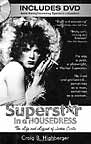
Superstar in a Housedress: The Life and Legend of Jackie Curtis
by Craig B. Highberger
Chamberlain Brothers
How to order
One of the best films of 2002 was David Weissman and Bill Weber's
The Cockettes, a funny, moving, and vital documentary about the San Francisco-based gender-fuck theater troupe
of the 1970s. Fueled by acid and speed, and costumed in stolen clothes, remnants from the trash, and lots of glitter, The Cockettes revolutionized both theater and gay culture by
bringing a sharp political edge to the well-worn homosexual sensibility of camp, and bringing the primary message of gay liberation be yourself, fuck propriety to nonpolitical audiences.
Craig B. Highberger's new book Superstar in a
Housedress is an OK book really just a series of interviews, some of Curtis's play scripts, and an assortment of photos
cut-and-pasted to form a brief narrative of the Warhol star's all-too-short career. But even if
Superstar-the-book is weak, luckily it comes with a DVD of Highberger's full-length documentary (with the
same title), and the DVD is terrific, nearly as good as The Cockettes themselves. As a book/DVD package,
Superstar in a Housedress is a fabulous combination.
The following is for anyone who missed queer culture in the 1960s and 70s: Jackie Curtis born John Holder in 1947 was a poor boy from the Lower East Side who, at age 12,
after seeing Carol Burnett in Once Upon a
Mattress, decided that he was going to be a superstar of the theater. By 16 he was doing drag, and by 17 changed his name to Jackie Curtis and
was performing at New York's famous experimental theater La Mama. By 1966, Curtis along with Candy Darling and Holly Woodlawn are the premiere drag queens of New York and hanging
out with the Warhol set. Curtis begins writing
plays Glamour, Glory, and Gold: The Life and Legend of Nola
Noonan, and Lucky Wonderful which are off-off Broadway hits playing to an
uptown crowd, as well as the rag-tag, bo-ho downtown set. In 1968 Jackie Curtis and Holly Woodlawn are in Andy Warhol's
Flesh and become the darlings of the new avant-garde. During the
1970s, Curtis becomes even more famous and more addicted to drugs, liquor, and gender bending often appearing as a butch James Dean-type as well as a fabulous
faux 30s movie star. During the 1970s the downtown scene begins to spin out of control more drugs. Candy Darling dies of leukemia, Curtis has plays produced but never breaks into the mainstream, and on May
15, 1985, Jackie Curtis dies of an accidental heroin overdose.
Jackie Curtis was a bright light in the New York scene of the 1970s and while not a flash-in-the-pan he has been, largely, lost to history. That is why
Superstar in a Housedress is such a needed endeavor. Highberger takes a standard approach to documentary filmmaking, and the DVD is composed mostly of talking heads that include everyone from headliners such as
Lily Tomlin, Harvey Fierstein, and Sylvia Miles to downtown royalty like Paul Morrissey, Taylor Mead, Augsto Machado, and Penny Arcade (who was friends with Curtis since high school
days). There's even Curtis's brother, Timothy Holder, who is a gay Episcopal priest.
But the real thrill and historic importance of the DVD (as well as the book) is that Highberger has rare film and video footage of many Curtis performances and plays. The
Cockettes were hindered in this respect because there was so little footage of their performances available from the early 1970s. But time and New York egos ensured that a great deal of
footage exists of Curtis.
This is fascinating archival material, and we get a real sense of the intensity and raw talent that Curtis brought to his work. Even when the footage is not very high quality these
are, essentially, home movies they display an incredible verve, anarchistic sense-of-theater, and the absurd. Curtis deploys a camp sensibility to critique the US government in plays such
the 1972 Amerikan Cleopatra. And there's sly humor in the (surprisingly not particularly misogynist) 1971 Warhol film (directed by Paul Morrissey) about women's liberation titled
Women in Revolt. One clearly sees a more serious aspect to works that were regarded as trash then and even now. (Interestingly, while the
Women in Revolt's original title was
Sex, it was always rumored that its working title was
P.I.G.S.-- Politically Involved
Girls, which would have worked much better.)
So much of this history and material as been lost, it is a boon to have it preserved in Highberger's book and film. While there's not a lot of analysis here although the talking heads
are often quite informative Superstar in a
Housedress is a terrific addition to the growing writings of gay cultural history.
| Author Profile: Michael Bronski |
|
Michael Bronski is the author of
Culture Clash: The Making of Gay
Sensibility and The Pleasure
Principle: Sex, Backlash, and the
Struggle for Gay Freedom. He writes
frequently on sex, books, movies, and
culture, and lives in Cambridge,
Massachusetts. |
| Email: |
mabronski@aol.com |
You are not logged in.
No comments yet, but
click here to be the first to comment on this
Book Review!
|