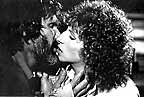
Kiss me for real like they do in the movies
|
 |
A more apt title for the re-release of Funny Girl
By
Michael Bronski
Funny Girl
Directed by William Wyler
starring Barbra Streisand
How to order
The re-release-- in a new beautifully restored print-- of Barbra Streisand's 1968 debut film
Funny Girl is reason enough to celebrate. William Wyler's smart, witty, emotionally satisfying
film version of the Broadway show is a screen classic and probably the last of the great Hollywood musicals. (Films that came later-- including
Fame, Grease, and Evita-- were essentially
full-length pre-and-post MTV videos.) Funny
Girl is an assured, beautifully photographed film that shows both the grace and ingenuity of Wyler's directorial hand. Not surprising since he had in the
decades before turned out such great films as Wuthering
Heights, The Letter, The
Heiress, and The Best Years of Our
Lives. But, of course, one of Wyler's great decisions in making the film was letting
Barbra Streisand be exactly who she was in her portrayal in Broadway and Ziegfeld Follies' star Fanny Brice. While Streisand's acting and singing bears little relationship to Brice's performance style
(she has none of the original's brightness or edge), her screen debut is energetic, willful, and altogether captivating. But aside from ushering in this new talent,
Funny Girl-- particularly as viewed in retrospect-- marked another milestone cultural moment as well: it is here we can see the direct influence of gay culture on performance and gender styles. Simply put: Barbra Streisand acts like
a drag queen.
Watching Funny Girl now is relatively, but pleasingly, alarming. In 1968, when the film was released, Streisand's performance seemed uniquely original. It was everything she had
perfected in over two years of playing the part on stage, but with the subtlety of a film actress: succinct, sprightly, direct, self-mocking, and very focused. We had a terrific sense of what it was like to be
a woman who used her wit to upstage the fact that she didn't feel beautiful, and who could, instinctually, deflect a potential emotional injury with a one-liner. Even the way that she carried her
body and used her hands was extravagant and self-protective. Streisand's performance of Fanny Brice was calculated to portray the stage legend in large, instantly understandable brushstrokes. But
even more to the point, it was engineered to hide how Streisand pulled it all off-- which was by imitating rather then really acting. And who better to imitate when playing a woman-- particularly
a somewhat flamboyant woman comic who had already become a staple of camp-- than drag queens?
Streisand's early performing years were spent in clubs in the Village (such as the Lion's Head and Bon Soir) that, if not completely gay, had a large gay clientele. Her earliest fans (and
advisors) were gay men who introduced her to the popular songs of the 1930s and '40s that became her early staple repertory. It's no surprise that she would also take from this gay culture a camp and
drag sensibility. Her interpretation of Fanny Brice in
Funny Girl is the ugly ducking who uses wit as an instrument of protection, resilience, and survival, and Streisand plunges into the role-- with
the appropriate hand gestures, ironic eye motions, and sharp-edged delivery-- of a female impersonator. This, of course, is something that Mae West did in the 1930s and that Bette Midler did
with ironic self-consciousness in the 1970s, and it's no surprise that all three became stock material for drag queens.
At times watching Funny Girl is like watching a drag queen
do Barbra doing Barbra-- it is what the French post-structuralists would call hyper-reality, or the simulacra-- a copy of a copy.
She isn't playing a woman, or even Fanny Brice; she is playing a woman playing Fanny Brice. Interestingly, in her next film,
Hello Dolly Streisand begins to morph into Mae West-- or is it a Barbra
drag doing Barbra doing Mae? Streisand's performance in
Funny Girl has power, but it is the potency of the exaggerated gesticulation and the stylized gesture that is the basis for all great drag
queens and their more humble, and no less talented, impersonators.
| Author Profile: Michael Bronski |

|
Michael Bronski is the author of
Culture Clash: The Making of Gay
Sensibility and The Pleasure
Principle: Sex, Backlash, and the
Struggle for Gay Freedom. He writes
frequently on sex, books, movies, and
culture, and lives in Cambridge,
Massachusetts. |
| Email: |
mabronski@aol.com |
You are not logged in.
No comments yet, but
click here to be the first to comment on this
Movie Review!
|