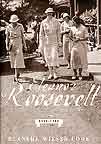
Eleanor Roosevelt: 1933-1939
|
 |
Eleanor Roosevelt's queer side
By
Michael Bronski
Eleanor Roosevelt: 1933-1938
Blanch Wiesen Cook
Viking Press
How to order
When in 1978, historians discovered love letters between Eleanor Roosevelt and Lorena Hickcock, the world was shocked: the first woman of America was a dyke. Well, almost. Blanche Wiesen Cook's first volume of her authoritative, exhaustive biography of Eleanor Roosevelt, published in 1992, radically redefined perceptions of Roosevelt's private life and elucidated the enormous role she played in the nation's public life. In this second volume Eleanor Roosevelt: 1933-1939 (Viking, cloth, $34.95), Cook once again proves herself a masterful historian and writer. The volume begins with Eleanor and Franklin-- unhappily married-- moving to Washington
to begin FDR's administration and craft the New Deal. It ends with
Kristallnacht and the inevitability of a European war.
Cook has a steely command of facts and an eye for salient detail. She demonstrates how the President and First Lady-- amid profoundly differing visions that
often broke into public disagreement-- entered into a delicate, mutually beneficial relationship of trust, advisement, and political action. But Cook is at her best
when examining how Eleanor's political concerns-- about human rights, the role of women, race relations, and social welfare-- helped define the New Deal.
Surprisingly-- and here Roosevelt's lesbianism comes into play-- much of the First Lady's politics around these topics came out
of her intimate relationships with such lesbian-inclined women as Nancy Cook, Marion Dickerson, and Jane Addams. Cook is terrific at
assembling and untangling huge amounts of personal and historical material and presenting it in graceful prose that conveys the import
and magnitude of her primary topic: how gender, sexuality, and personal relationships played a vital, defining role in the unfolding of a
new, progressive vision for the US and the world. For it was not only Roosevelt's lesbian friendships and social circle that influenced her, but
her complicated relationship with her husband as well. Easy ideas about sexual or queer politics are completely missing here. Cook is able
to illuminate intricate, often enigmatic, human relationships, and place them in a broader sphere of everyday private and public life.
| Author Profile: Michael Bronski |

|
Michael Bronski is the author of
Culture Clash: The Making of Gay
Sensibility and The Pleasure
Principle: Sex, Backlash, and the
Struggle for Gay Freedom. He writes
frequently on sex, books, movies, and
culture, and lives in Cambridge,
Massachusetts. |
| Email: |
mabronski@aol.com |
You are not logged in.
No comments yet, but
click here to be the first to comment on this
Book Review!
|