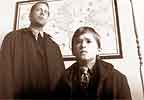
Something's going on here...
|
 |
Is Sixth Sense secretly queer?
By
Michael Bronski
The Sixth Sense
Directed by M. Night Shyamalan; with Bruce Willis, Haley Joel Osment.
How to order
Dudley Do-Right
With Brendan Fraser and Jessica Parker.
How to order
Summer has always been a season of queer movies. These were not necessarily
gay movies with openly gay or lesbians characters, but films that gave us a view of
the world in which the idea of the normal was thrown into question, explored with irony or camp.
But this summer? Hardly anything. A prime contender for queerness was
Dudley Do-Right, the live-action version of the comic melodrama that was a staple on
the old Rocky and Bullwinkle Show. Dudley was a deadly on-target parody of the hyper-idealized ultra-manly Canadian Mountie in movies like Cecil B. DeMille's
absurd Northwest Mounted Police (in which even the stalwart Gary Cooper looks fairly embarrassed).
Dudley-Do-Right mocked heterosexuality, romance, patriotism,
and manhood for millions of young viewers in the 1960s. Dudley was a lummox who could not find the right end of his horse. His sweetheart was Little Nell,
ostensibly naive and innocent but, in reality, brainy and sarcastic.
When the film version of the Do-Right story was announced last year to be starring Brendan Fraser as Dudley and Sarah Jessica Parker as Nell, the casting
looked perfect. Fraser had already shown himself to be a great satirist of junk pop- culture in
George of the Jungle and Blast From the
Past, and Parker conveys a savvy, knowing sensibility in all of her work.
But somehow Dudley Do-Right was done all wrong. At first Brendan Fraser's Do-Right is cute, clumsy, and unencumbered with any lack of common sense.
He repeatedly smashes himself in the face with a floorboard and thinks nothing of wearing the grotesque stuffed moose head that has fallen onto him. But as the
film progresses, it falls apart. Fleeing from its seditious roots as an
echt anti-romance, this Dudley
Do-Right turns its knuckle-headed Mountie into a proper, lovable,
and romantic hero. What a waste.
The cartoon versions of Dudley
Do-Right were traitorous in their comic assaults on Western culture and common decency. Along with
Mad Magazine and provocative comics like Lenny Bruce,
Rocky and Bullwinkle was one of the important attacks on early 1960s cultural complacency. The film version is both a fraud
and a disappointment.
The "gay movies" of the summer are as un-queer and mainstream as
Dudley Do-Right. Rose Troche's Bedrooms and
Hallways is a terrible mess, less interesting
and intelligent than Go Fish, her middle-brow, boring hit of several years ago.
Floating-- a serious, independent film by William Roth-- has moments of emotional
intensity as it tells about a gay boy trying to break away from his father and find his place in the world-- but it is mired in a sink-hole of supersensitive realism that
drowns whatever heart and soul it has. Anne Wheeler's
Better Than Chocolate has some nifty dyke sex scenes and a cool subplot in which a straight 17-year-old boy
is introduced to anal sex by his older bisexual girlfriend, but its reliance on romantic clichés and deeply inept writing make its perfectly un-queer. Todd William's
The Adventures of Sebastian Cole-- teen-boy coming of age with trannie dad-- was equally inept as well as catering to a middle-of-the-road, traditionalist sensibility.
Perhaps the queerest movie of the summer is M. Night Shyamalan's the surprise-hit of a supernatural-psychological thriller
The Sixth Sense-- with Bruce Willis
and Haley Joel Osment. Originally marketed as a routine summer ghost story,
The Sixth Sense is a far more complicated, unnerving look at the difficulties and horrors
of childhood and the fear of dealing with "big" issues like death and responsibility.
Osment plays Cole, an eight-year-old who is perceived by his mother, teachers, and other kids as "having a problem." He is moody, quiet, interior, and
desperately secretive. And he does have a secret-- Cole "sees dead people" and is afraid to tell anyone about it lest he be seen as more of a freak. Of course, everyone thinks he
is already a freak because of his behavior: his mother does not understand him, his teachers barely tolerate him, and his schoolmates torture him. In comes famed
child psychologist Dr. Malcolm Crow (Bruce Willis), who draws the boy out with trust and hesitant friendship only to find that Cole has as much effect on him as he has
on the boy.
The Sixth Sense is beautifully written and directed. While its psychological-thriller aspect is effective, even moving, it is
Osment's performance as the sensitive-boy-with-a-secret that most unnerves. Fragile yet strong-willed, Cole is the embodiment of every queer
kid who has undergone the terrors of being different. It would be easy to say that Cole's secret-- seeing dead people-- is a metaphor for
being gay, but this would detract from the complexity of
The Sixth Sense. The film delineates Cole's outsiderness with such feeling,
precision, and tenderness that it's both painful and exhilarating. While there is nothing "gay" about
The Sixth Sense it's surely the queerest--
and perhaps best-- film of the summer.
| Author Profile: Michael Bronski |

|
Michael Bronski is the author of
Culture Clash: The Making of Gay
Sensibility and The Pleasure
Principle: Sex, Backlash, and the
Struggle for Gay Freedom. He writes
frequently on sex, books, movies, and
culture, and lives in Cambridge,
Massachusetts. |
| Email: |
mabronski@aol.com |
You are not logged in.
No comments yet, but
click here to be the first to comment on this
Movie Review!
|