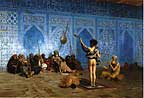
Degenerate Arabs?
|
 |
The following is an excerpt from an interview with Joseph Massad, who teaches intellectual history and Arab politics at Columbia University in New York City. More of the interview will be posted here in the coming weeks. For an essay on Massad's new book Desiring Arabs click here
The Guide: Your work focuses on how radically different erotic desire is
conceived in different cultures. But people seem remarkably able to adapt. You hear
about men from the more overtly repressive parts of the Middle East Saudi Arabia
coming to the West saying they feel like they're in a candy store. Or Westerners travel
to the Middle East and find that there's a different way same-sex desires
happen, but in short order it often all seems to make sense. Or people get sent to
prison, and fall into a new sexual roles they wouldn't have imagined playing before.
Doesn't this ready adaptability call into question the idea of irreconcilable, radical
cultural differences when it comes to sexuality? Or that the way language is used
around desire determines people's experiences?
Joseph Massad: It's not just language and discourse, but also structures
such as law and the state more generally. But it seems to me that when Arabs
who have same-sex desires or those who have different sex desires come to the
US, they find their desires, which were not beholden to the hetero-homo binary,
as intelligible only as "gay" or "straight." This is on account of the closure
of possibilities in the West, especially since the 1950s, for the multiple ways
in which sexuality is organized outside the hetero-homo binary. The last opening
for these multiple ways of understanding sexual desires to exist was the Kinsey
reports, which were ultimately overthrown. Kinsey thought that sexuality existed on
a spectrum of behavior and desires, where the majority are somewhere in the
middle and a few are on the extremes. By the '70s the medical and genetic model
of sexuality became fully entrenched, and one came to be apprehended only
as either heterosexual or homosexual and that the two are discrete forms of
desires and identities. It's not unlike certain theories of race in the U.S. The racist
idea that "one drop of black blood makes you black" gets translated into
"one homosexual experience makes you homosexual" --
incontrovertiblywhiteness and heterosexuality in this understanding must remain uncontaminated by a
single non-heterosexual experience or single drop of non-white blood. As a result,
people can no longer experience same-sex contact without existential angst
and identitarian imperatives, and when they encounter other cultural formations,
same-sex desire "there" is intelligible to them only in terms of gayness "here."
While this could be said to be understandable, it's terribly inaccurate. When
activism comes to be based on it, it becomes terribly cruel.
I think there's been a recognition in the West that something different
goes on in Latin America, in south Asia, in Africa, and in Arab countries compared
to northern Europe and the U.S. There's recognition that there's something
different even in certain black and Latino communities in the U.S., with what's
sometimes called the "down low." At the same time, there's anxiety about these
sexual desires and practices, and a demand to assimilate them to the
homo/hetero binary, with its radical mutual exclusivity. There's a sense that the only
way forward for them is to follow in "our" tradition, that the endpoint "we"
have reached of gayness is the way to liberation. If you resist, you may be accused
of being homophobic or deluded, or a nativist, or someone that just hates the
West. There's no recognition that in fact what these gay internationalist groups
are doing, wittingly or not, is imposing a White middle class European
supremacist notion of how societies should be sexually organized, and that the best way
to organize them is the Western way.
My work is about demonstrating the limitations and contingent nature
of nationalism and identities in general. So my interest is actually a critique of
both nativism in the Arab world, in Africa and Latin America, and of European
supremacist nativism. By saying that the local is important, my aim is not the preservation
of some sort of imagined "authentic." I am explaining that locally-generated
economic, social, and sociological, processes lead people to have different ideas and
to assume different identities, which is hardly a radical proposal.
To impose that kind of project on the rest of the world, of how human
life should be lived and how human sexual desires should be organized in the name
of "liberation," is a quintessential imperialist operation -- with all the
negative connotations of that term. But this operation fails on its own terms. But to
those sympathetic to this kind of project I would tell them that their effort
doesn't attain the goals it sets out for itself. Instead, it's backfiring, bringing about
more oppression and not the liberation they claim to want to bring about. This is not
in defense of the "authentic," or to say that there is no oppression of people
based on sexual desires. Of course there is, "here and there." But the point is not
to have Westerners force a transformation of the lives of "non-Westerners" in
this manner and to let people organize or experience their own desires in the way
that they see fit, and to recognize what's at stake for them in accepting the
imposition of Western sexual identities. And if their desires and sexual practices and
their social and economic contexts lead them to assume the same identities that it
has led to in the West (which in most cases it has not), and individuals opt to
organize themselves in that way and then require and ask for Western solidarity,
then these Western gay internationalist groups would be called upon then (not
before) to give support -- but not to lead the struggle, rather to give support and
offer alliances and learn from the experience of other people, and not try to
teach them and impose on them their own "Western" experiences and
understanding. What we have today is the do-gooder attitude, this sense of a kind of
white-man's burden, that "We will go and liberate them despite themselves."
Remember, this white-man's burden was always an alibi for economic exploitation and
military conquest. And so the road to hell is paved with good intentions.
You are not logged in.
No comments yet, but
click here to be the first to comment on this
Magazine Article!
|